Boqonnaa 2 Keemistirii kutaa 11
How the Born-Haber cycle finds the lattice energy of salt
1:28 · Ibsa 3 boqonnaa 2 keessaa 2ffaa
Ibsa animeeshinii Temari gabaabaa boqonnaa 2 Keemistirii kutaa 11: How the Born-Haber cycle finds the lattice energy of salt. Ibsonni kun Afaan Ingiliziitiin.
Wanta ibsichi jedhu hunda
Jechoota ibsichaa kutaa kutaan, akkuma barreeffama viidiyoo irratti mul'atan.
Salt made in one step
Sodium and chlorine react in one step to make sodium chloride, giving out 411 kJ per mole.
Its lattice energy is the energy change as gas ions pack into the solid.
That is hard to measure, so we go the long way round.
The long way climbs first
First, solid sodium turns into a gas, taking in 108 kJ.
Chlorine molecules split into atoms: half of 240, so 120.
Each sodium atom loses an electron: 496 more.
Then energy comes out
Each chlorine atom takes that electron and gives out 349.
Now the ions are made, 375 kJ above where we started.
The last drop, into solid salt, is the lattice energy.
Both routes match
Both routes start and end in the same place, so by Hess's law their totals are equal.
So the lattice energy is −411 − 375, which is −786 kJ/mol.
Ionic solids exist only because this drop is so big.
Born-Haber cycle for NaCl
Climb to the ions, and the lattice energy is the drop that brings you down to the salt.
Save this one for revision.
Barnoota guutuu boqonnaa 2
Barnoota viidiyoo Temari dheeraa boqonnaa kanaa; wanti inni jedhu hundi fuula isaa irratti barreeffameera.
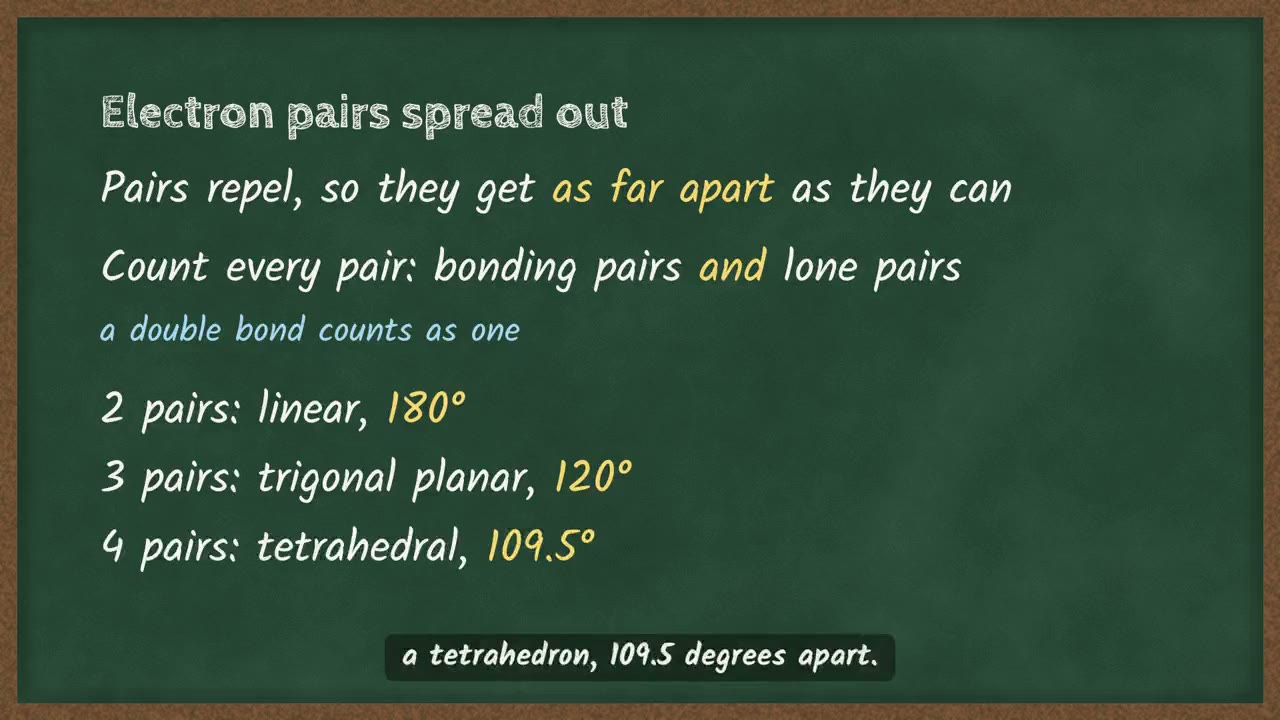 How lone pairs bend a moleculedaqiiqaa 4
Dabalata boqonnaa 2
Fuulli boqonnaa kanaa wanta Temari boqonnaa kana irratti qabu kan hafe qaba, fakkeenyaaf yaadannoo gabaabaa fi gaaffii shaakalaa deebii isaanii waliin.
Fuula boqonnaa 2 baniBoqonnaa kana appii keessatti shaakali
Temari boqonnaa kana gara shaakala yeroon daangeffametti jijjiira; utuu hojjettuu ni sirreessa; wanti si hin galinis barsiisaa AI tiin ni ibsama.
Bilisaan jalqabi
Temari.et appii Android qaba; Google Play irratti bilisaan argama.

