Grade 10 Biology unit 3
Why some proteins are balls and others are strands
1:15 · Explainer 3 of 3 on unit 3
A short animated Temari explainer on Grade 10 Biology unit 3: Why some proteins are balls and others are strands. Free to watch, no account needed.
Everything the explainer says
The explainer's words, part by part, as its captions show them.
A protein is a chain
A protein is a long chain of amino acids.
Each one carries an R group, and some R groups are hydrophobic: they avoid water.
Curled into a ball: globular
In the watery inside of a cell, or in blood, many chains curl up into a ball.
The hydrophobic R groups point to the centre, away from the water.
This is a globular protein, and its precise shape is the key to how it works.
Enzymes, haemoglobin and antibodies are globular.
Long strands: fibrous
Other proteins do not curl up. They form long strands that usually do not dissolve in water.
These fibrous proteins build the body.
Keratin makes hair and nails, and collagen is in skin, tendons and bones.
What the exam asked
A national exam asked which of these is made of globular proteins.
Keratin and collagen are fibrous, and glycogen is a carbohydrate.
The answer is A: enzymes.
Protein shapes
So globular proteins curl up into balls, and fibrous proteins form long strands.
Save this one for revision.
The full lesson on unit 3
Temari's longer video lesson on this chapter, with every word written out on its page.
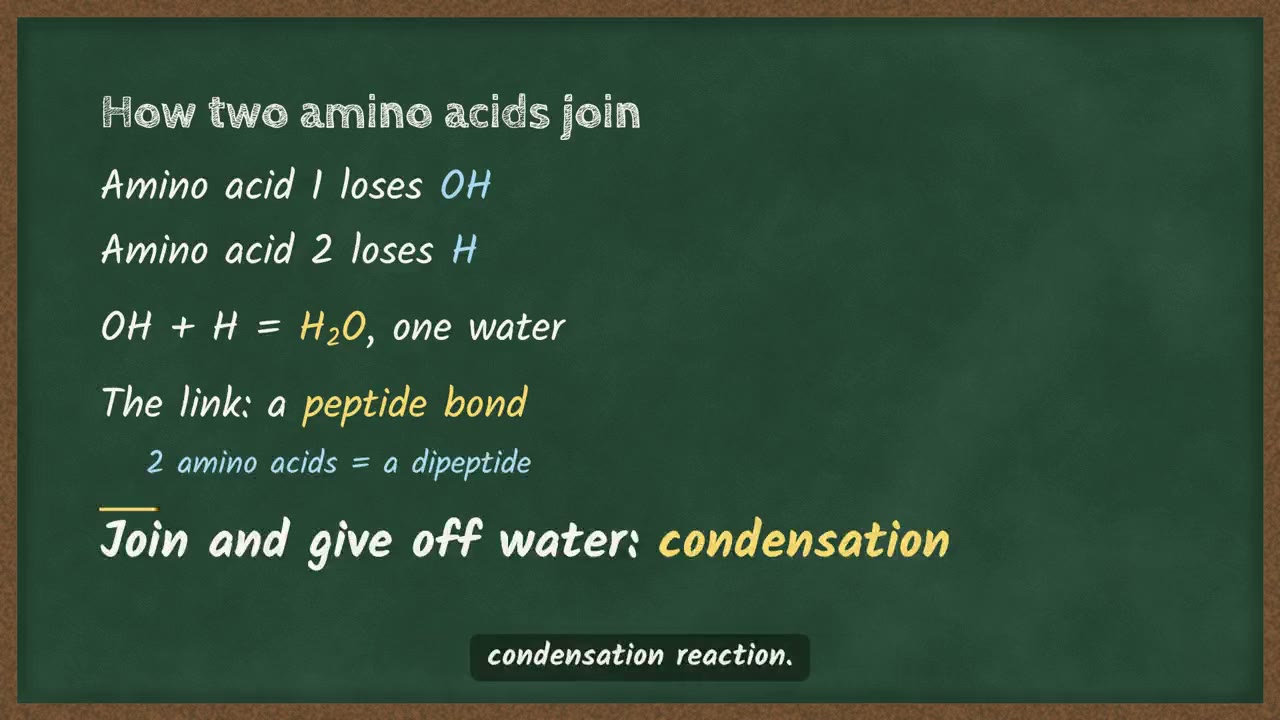 One bond, one water: building big molecules4 min
More explainers on unit 3
More on unit 3
The chapter's own page holds the rest of what Temari has on it, such as short notes and practice questions with their answers.
Open the unit 3 pagePractise this unit in the app
Temari turns this chapter into timed practice and marks it as you go, with an AI tutor to explain anything that did not land.
Start free
Temari.et is also an Android app, free on Google Play.

