Grade 10 Physics unit 6
Seven colours from one beam: why violet bends most
1:27 · Explainer 1 of 2 on unit 6
A short animated Temari explainer on Grade 10 Physics unit 6: Seven colours from one beam: why violet bends most. Free to watch, no account needed.
Everything the explainer says
The explainer's words, part by part, as its captions show them.
White light holds seven colours
Shine a beam of white light into a glass prism.
It spreads into seven colours: red, orange, yellow, green, blue, indigo and violet.
Each colour bends a different amount: red the least, violet the most.
This spreading is called dispersion.
Why? Each colour has its own wavelength
Light is a wave, and its wavelength is the distance from one crest to the next.
Violet has the shortest wavelength, and red the longest.
The shorter the wavelength, the more the colour bends.
Same speed, more waves
Every colour travels at the same speed, c: 300,000,000 m/s in a vacuum.
In the same time, violet makes more waves.
Its frequency, the number of waves each second, is higher.
Work it out: c = fλ
Speed is frequency times wavelength: c = fλ.
For violet light of wavelength 400 nm, f = c ÷ λ.
That gives 7.5 × 10 to the power 14 Hz.
Dispersion and the speed of light
Remember c = fλ. Violet bends the most.
Save this one for revision.
The full lesson on unit 6
Temari's longer video lesson on this chapter, with every word written out on its page.
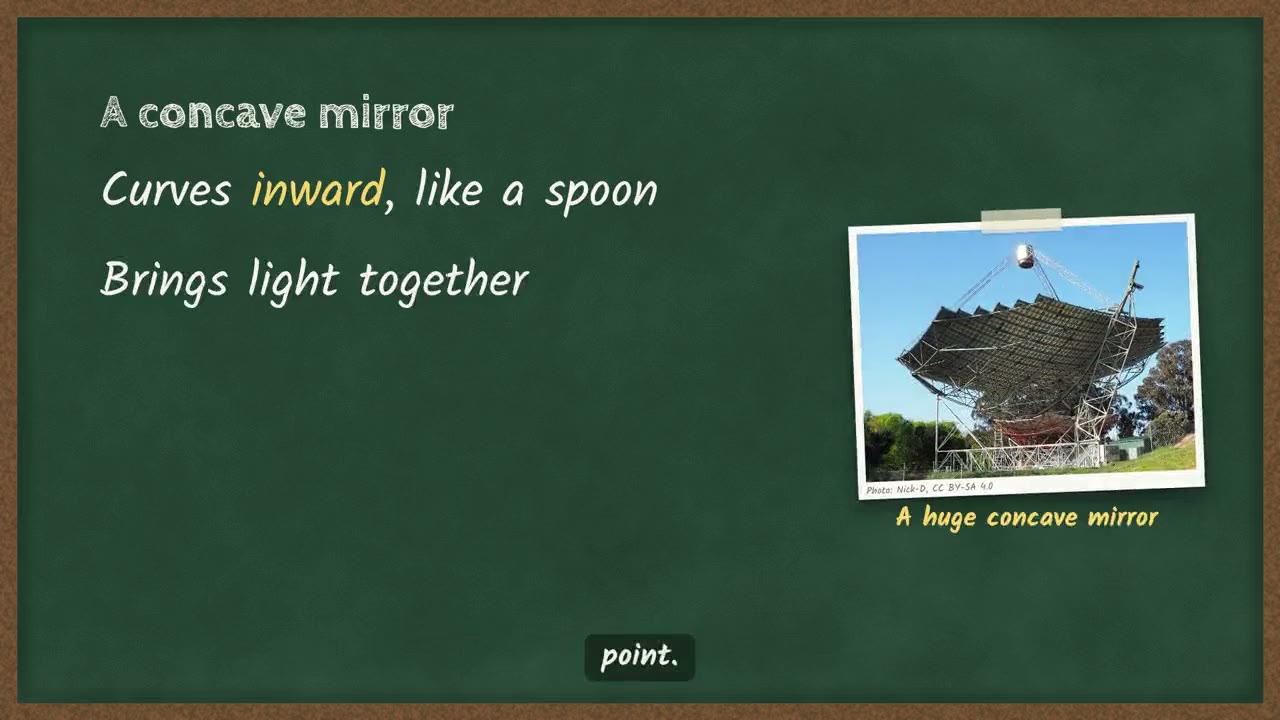 Where a concave mirror puts the image4 min
More explainers on unit 6
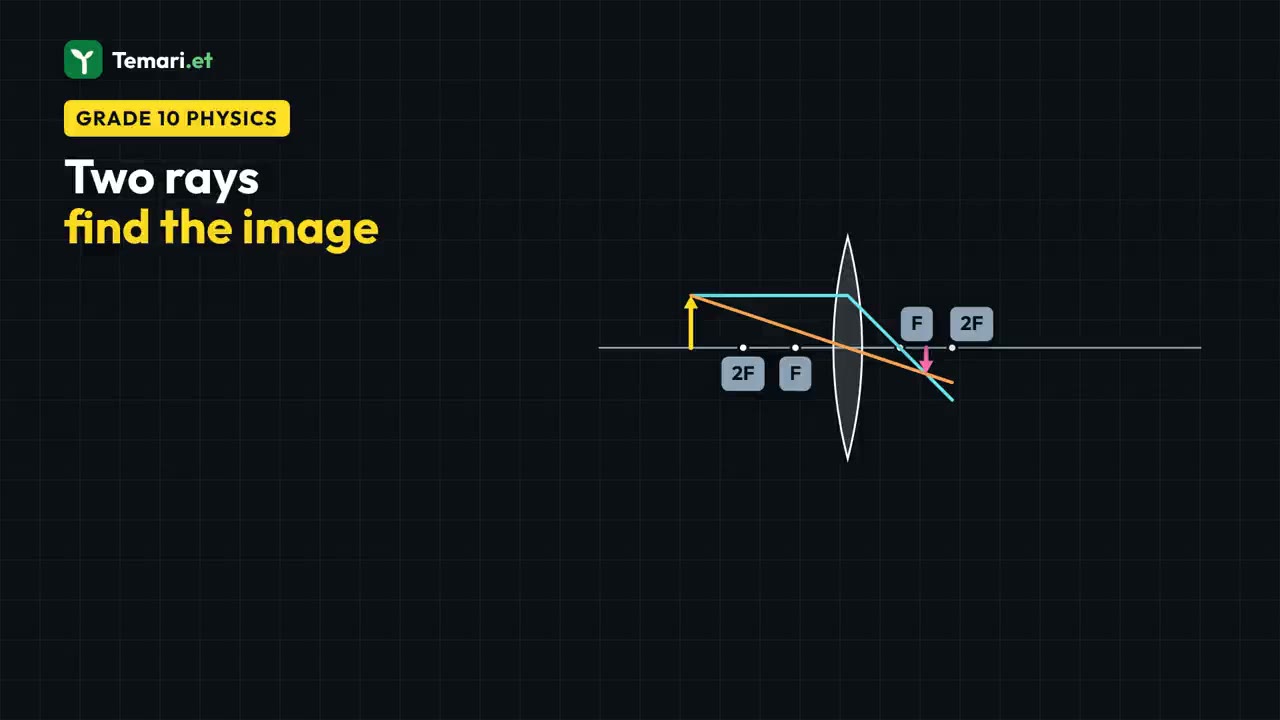
More on unit 6
The chapter's own page holds the rest of what Temari has on it, such as short notes and practice questions with their answers.
Open the unit 6 pagePractise this unit in the app
Temari turns this chapter into timed practice and marks it as you go, with an AI tutor to explain anything that did not land.
Start free
Temari.et is also an Android app, free on Google Play.

