Grade 11 Mathematics unit 2
Where a rational function settles: the horizontal asymptote
1:24 · Explainer 1 of 2 on unit 2
A short animated Temari explainer on Grade 11 Mathematics unit 2: Where a rational function settles: the horizontal asymptote. Free to watch, no account needed.
Everything the explainer says
The explainer's words, part by part, as its captions show them.
Where does the graph settle?
Take f(x) = 1/x. At x = 1, f is one. At ten, f is one tenth. At a hundred, one hundredth.
The values close in on zero, so the line y = 0 is a horizontal asymptote.
This one settles at three
Now the book's h(x) = (3x² + 1)/(x² + 4x + 4).
At ten, h is about 2.09. At a hundred, about 2.88. At a thousand, about 2.99.
It closes in on three, so the line y = 3 is its horizontal asymptote.
The big terms win
Why three? When x is large, the x squared terms are far bigger than the rest.
Keep only those, and you get 3x² over x², which is three.
So when the top and the bottom have the same degree, the asymptote is the ratio of their leading coefficients.
For 1/x, the bottom has the higher degree, so the graph settles at zero.
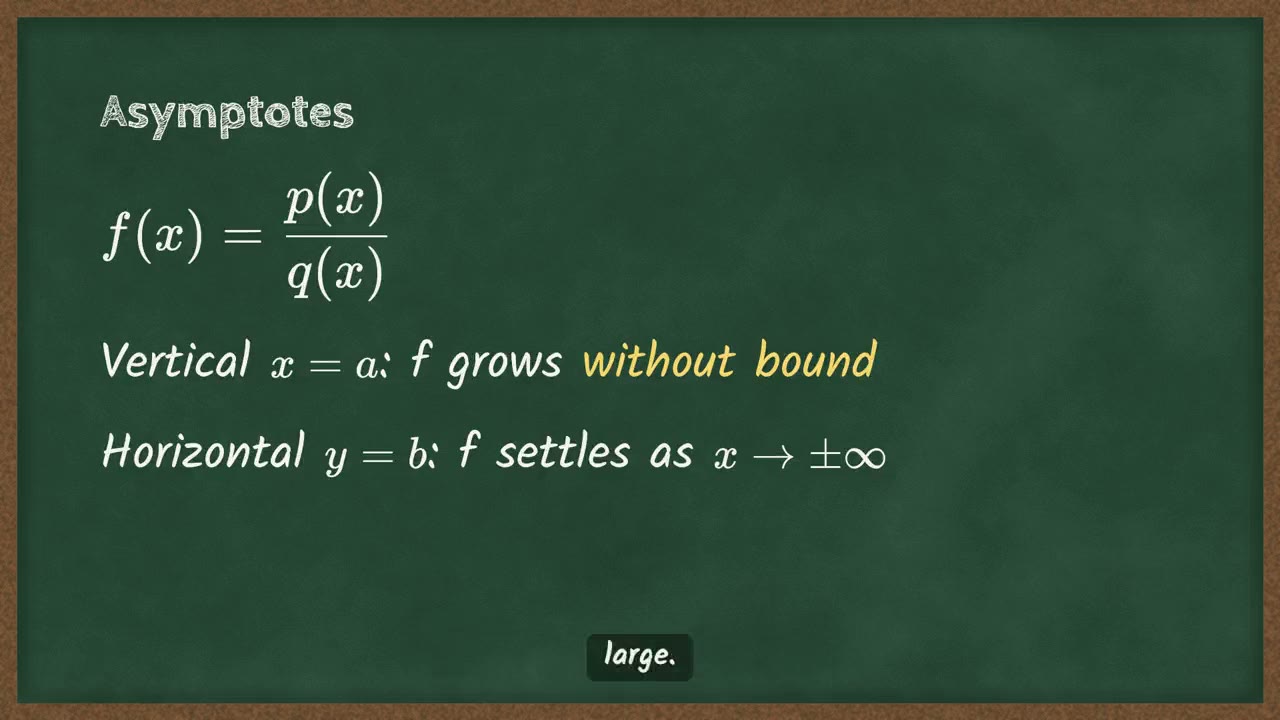
Horizontal asymptotes
A horizontal asymptote is the height a graph settles at as x grows without bound.
Save this one for revision.
The full lesson on unit 2
Temari's longer video lesson on this chapter, with every word written out on its page.
 Vertical asymptote or hole? Cancel first4 min
More explainers on unit 2
More on unit 2
The chapter's own page holds the rest of what Temari has on it, such as short notes and practice questions with their answers.
Open the unit 2 pagePractise this unit in the app
Temari turns this chapter into timed practice and marks it as you go, with an AI tutor to explain anything that did not land.
Start free
Temari.et is also an Android app, free on Google Play.

