Grade 11 Mathematics unit 4
Three points, one curve: polynomial interpolation
1:25 · Explainer 2 of 2 on unit 4
A short animated Temari explainer on Grade 11 Mathematics unit 4: Three points, one curve: polynomial interpolation. Free to watch, no account needed.
Everything the explainer says
The explainer's words, part by part, as its captions show them.
One curve through three points
Three data points: (0,1), (1,2) and (2,22).
A straight line through the first two passes far below the third.
So which curve goes through all three?
Each point gives an equation
Try the curve p(x)=a+bx+cx².
Each point lies on it. Zero gives a=1.
One gives a+b+c=2, and two gives a+2b+4c=22.
A determinant that is not zero
The numbers in front of a, b and c form a matrix.
Its determinant is 2, which is not zero.
So the system has exactly one solution: one curve of this kind.
The curve, and a guess at three
Solving gives a=1, b=−8.5 and c=9.5.
That curve passes through all three points.
Now put in three to estimate the next value: p(3)=61.
Polynomial interpolation
Three points give three equations. A determinant that is not zero means exactly one curve.
Save this one for revision.
The full lesson on unit 4
Temari's longer video lesson on this chapter, with every word written out on its page.
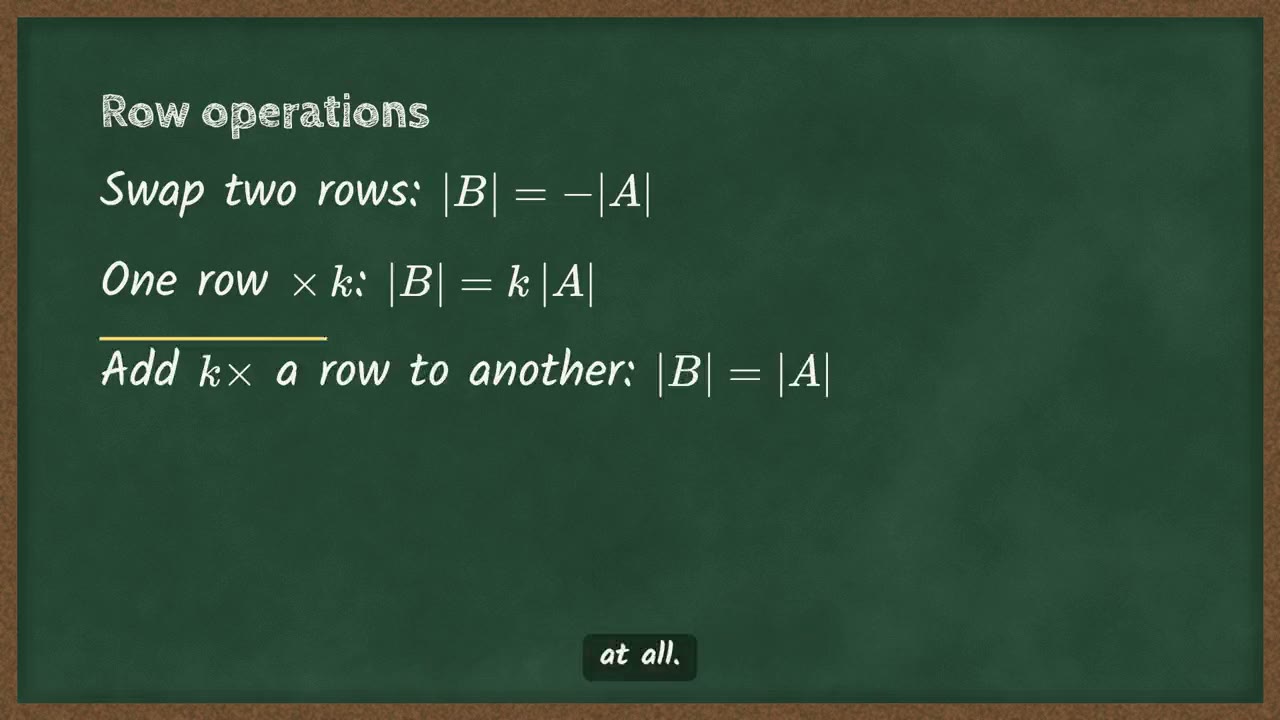 How a determinant changes when the matrix changes4 min
More explainers on unit 4
More on unit 4
The chapter's own page holds the rest of what Temari has on it, such as short notes and practice questions with their answers.
Open the unit 4 pagePractise this unit in the app
Temari turns this chapter into timed practice and marks it as you go, with an AI tutor to explain anything that did not land.
Start free
Temari.et is also an Android app, free on Google Play.

