Grade 12 Chemistry unit 1
How an indicator changes colour
1:27 · Explainer 3 of 3 on unit 1
A short animated Temari explainer on Grade 12 Chemistry unit 1: How an indicator changes colour. Every word it says is written out under the video.
Everything the explainer says
The explainer's words, part by part, as its captions show them.
Why does an indicator change colour?
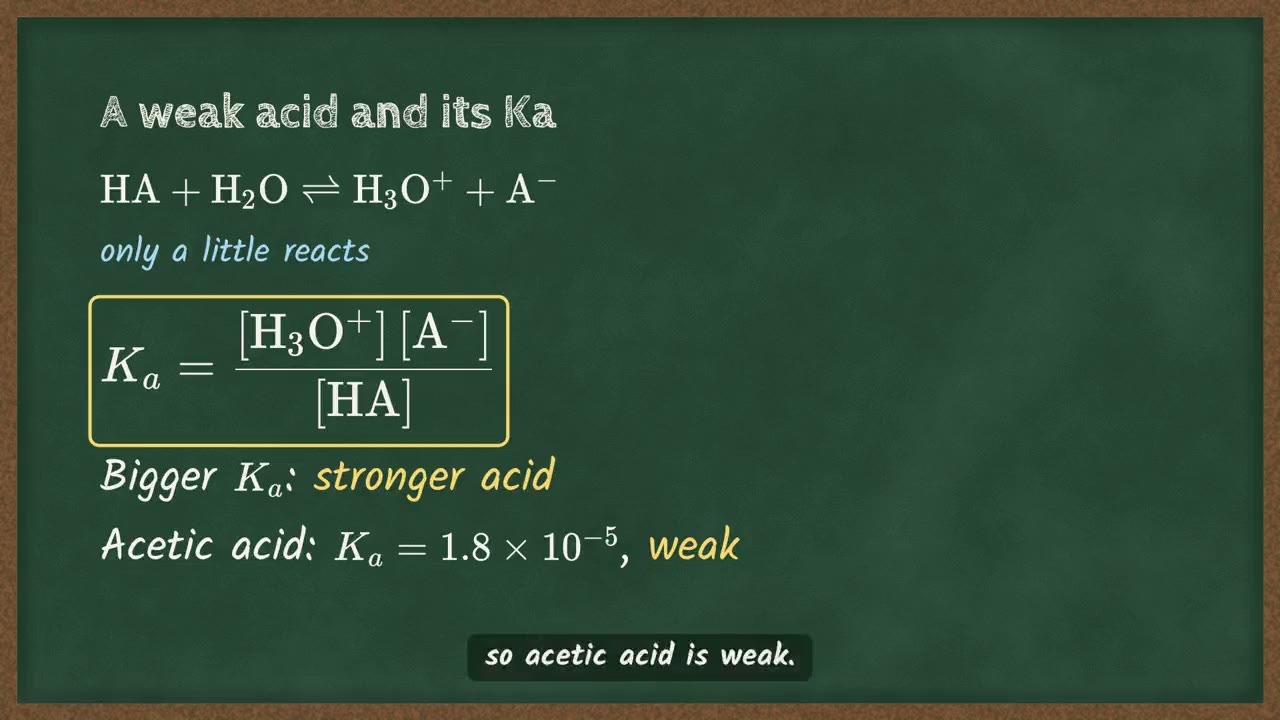
An acid base indicator is a weak acid. Call it HIn.
It gives a proton to water, making hydronium and its conjugate base, In−.
The two forms have different colours. Methyl orange is red as HIn and yellow as In−.
In acid: red
In an acidic solution, hydronium is high.
By Le Chatelier's principle the equilibrium shifts to the left, and most of the indicator stays as HIn.
You see the acid colour: red.
Add base: yellow
Now add base. It removes hydronium ions.
The equilibrium shifts to the right, and HIn gives up its proton to become In−.
The solution turns yellow, the base colour.
Each indicator has its own range
The colour changes across a range of pH, and each indicator has its own.
Methyl orange turns from red to yellow between pH 3.2 and 4.4.
Phenolphthalein turns from colourless to pink between 8.2 and ten.
Acid-base indicators
An indicator's two forms have two colours. Acid pushes it to HIn, base pulls it to In−.
Save this one for your exam.
The full lesson on unit 1
Temari's longer video lesson on this chapter, with every word written out on its page.
 The pH of a weak acid4 min
More on unit 1
The chapter's own page holds the rest of what Temari has on it, such as short notes and practice questions with their answers.
Open the unit 1 pagePractise this unit in the app
Temari turns this chapter into timed practice and marks it as you go, with an AI tutor to explain anything that did not land.
Start free
Temari.et is also an Android app, free on Google Play.

