

Grade 12 results are out. Where to check yours

Unit notes and practice questions

Grade 12 English unit 8: Telemedicine

Everything here is for unit 8 of the Grade 12 English textbook: what the chapter covers, the short notes, practice questions with their answers, and the lesson video where one exists.

Get it on Google Play
6
Cards
10
Practice questions on unit 8
180–214
The textbook pages for unit 8

Start here

The Temari lesson on unit 8

A short video lesson on this chapter, made by Temari. It loads only when you press play.

Present becomes past: reporting a statement · 4 min · 2 past exam questions worked through

Parts of the lesson

Tap a part to play the lesson from there.

The lesson on its own page, with every word written out

Short explainers

Short explainers on unit 8

Animated videos of a minute or two, each on one idea from this chapter. Tap one to watch it on its own page, with every word written out.

Short notes for unit 8

The cards filed under this chapter on the Grade 12 English page. Open one at a time.

When you use it

Reach for this when you must decide whether a verb in a sentence is in the active or the passive voice, or when you must change one into the other.

Watch out

A verb with no object is still active: 'live' in 'More than 80% of the population live in rural areas' is active. Passive needs a form of be followed by a past participle, as in 'was aimed at' or 'is underserved'. Do not call a verb passive only because it describes a state.

Drafted from Grade 12 English, pages 180-214, then checked twice before it went up

When you use it

Use this when you report what someone said, for example 'Mr Brown said that...', and must turn the speaker's words into the reporter's point of view. The verb also moves back one tense, as in 'is' to 'was'.

Watch out

Do not leave 'I', 'we', 'my', 'your' or 'you' unchanged. Change them to fit who is speaking about whom, as in 'Dad said that they were grounded', not 'Dad said that you were grounded'.

Drafted from Grade 12 English, pages 180-214, then checked twice before it went up
When you use it

Use this when you choose the preposition that follows a verb, such as wait for, listen to or belong to, or when you decide that no preposition is needed.

Watch out

Learn each verb with its preposition as one unit. Discuss, reach and pay the bill take no preposition: 'Let's discuss the arrangements', 'We reached the airport', 'We paid the bill'. Do not write 'discuss about' or 'reach to'.

Drafted from Grade 12 English, pages 180-214, then checked twice before it went up

When you use it

Reach for this when a task asks you to prepare the plan for a meeting before it takes place.

Watch out

An agenda is written before the meeting and lists the topics in the order they will be discussed. Do not write it as a record of what was decided, because that belongs in the minutes.

Drafted from Grade 12 English, pages 180-214, then checked twice before it went up

When you use it

Use this when a topic asks you to argue for or against a claim, such as whether telemedicine should be practised in Ethiopia. The model essay runs: the issue, the opposing view, the rebuttal, the supporting points, then the conclusion.

Watch out

State your thesis clearly, usually as the last sentence of the introduction. Answer the other side with evidence such as a study, a survey or a figure, not with opinion alone, because a claim without facts loses the marks.

Drafted from Grade 12 English, pages 180-214, then checked twice before it went up

When you use it

Reach for this when you must write the official written record of a meeting that has already been held.

Watch out

Minutes report what happened, so write the reports in the past tense (for example, Solomon reported that the losses were 12 percent). Also include the time the meeting was called to order and the time it was adjourned, and name the absent members.

Drafted from Grade 12 English, pages 180-214, then checked twice before it went up

Practice questions on unit 8

10 multiple-choice questions written against this chapter, each with its answer and the reason. Try one before you open the answer.

Question 1

More than 80% of the Ethiopian population live in which type of area?

  1. A.rural areas
  2. B.the capital city
  3. C.regional cities
  4. D.private hospitals
Show the answer and why

Answer: A rural areas

Why

More than 80% of Ethiopians live in rural areas. This is why healthcare is hard to reach for many people in Ethiopia.

Question 2

What is the official written record of a meeting, prepared after the meeting has been held?

  1. A.agenda
  2. B.adjournment
  3. C.minutes
  4. D.objective
Show the answer and why

Answer: C minutes

Why

Minutes are the report written after a meeting. They are the official record of what happened in the meeting. An agenda is the plan made before the meeting.

Question 3

Which organization established the first telemedicine project in Ethiopia in 2003?

  1. A.Johns Hopkins University
  2. B.Swinfen Charitable Trust
  3. C.National Telemedicine Coordinating Committee
  4. D.International Telecom Union (ITU)
Show the answer and why

Answer: D International Telecom Union (ITU)

Why

The International Telecom Union (ITU) established the first telemedicine project in Ethiopia in 2003. Johns Hopkins University started its project in 2006, and the Swinfen Charitable Trust was established in 1998.

Question 4

Which sentence is written in the passive voice?

  1. A.Telemedicine connects patients to vital health care services.
  2. B.The project was aimed at ensuring access to affordable primary healthcare.
  3. C.Physicians at Jimma hospital use the Internet to consult specialists.
  4. D.The government of Ethiopia has implemented several programs.
Show the answer and why

Answer: B The project was aimed at ensuring access to affordable primary healthcare.

Why

A passive sentence has a form of be plus a past participle, and the subject receives the action. In "The project was aimed at ensuring access...", the project is the receiver of the action, so it is passive. The other three sentences are active, because the subject does the action.

Question 5

In 2014, the physician to population density of Ethiopia was 0.025 per 1000. What does this figure show?

  1. A.Ethiopia is one of the countries with the lowest physician to population ratio in the world.
  2. B.Ethiopia is one of the countries with the highest physician to population ratio in the world.
  3. C.Most doctors in Ethiopia work in rural areas.
  4. D.Every city in Ethiopia has enough physicians for its people.
Show the answer and why

Answer: A Ethiopia is one of the countries with the lowest physician to population ratio in the world.

Why

A density of 0.025 physicians for every 1000 people is very low. This makes Ethiopia one of the countries with the lowest physician to population ratio in the world. Most medical doctors are attached to hospitals in the larger cities, not to rural areas.

Question 6

The National Telemedicine Coordinating Committee (NTCC) was formed as a joint enterprise of three bodies. Which one of these was NOT one of the three partners?

  1. A.Federal Ministry of Health (FMoH)
  2. B.Ethiopian Telecommunication Authority (ETA)
  3. C.Black Lion Referral Hospital
  4. D.Medical Faculty of Addis Ababa University
Show the answer and why

Answer: C Black Lion Referral Hospital

Why

The NTCC was formed by the Federal Ministry of Health (FMoH), the Medical Faculty of Addis Ababa University, and the Ethiopian Telecommunication Authority (ETA). Black Lion Referral Hospital was the host of the first ITU project, so it was not one of the NTCC partners.

Question 7

Choose the correct preposition: “I never listen ___ the radio.”

  1. A.at
  2. B.to
  3. C.for
  4. D.on
Show the answer and why

Answer: B to

Why

The verb listen is followed by the preposition to. We say “listen to the radio”, not “listen on” or “listen for”.

Question 8

Change to reported speech: Mr Cooper said, “I take my medicine regularly.”

Mr Cooper said that he ___ his medicine regularly.

  1. A.takes
  2. B.took
  3. C.has taken
  4. D.is taking
Show the answer and why

Answer: B took

Why

When we report speech, the verb moves back one tense. The present simple take changes to the past simple took. The pronoun I also changes to he.

Question 9

Change the possessive word in reported speech: Karen and Liya said, “Our class is interesting.”

Karen and Liya said that ___ class was interesting.

  1. A.her
  2. B.their
  3. C.our
  4. D.your
Show the answer and why

Answer: B their

Why

In reported speech, our changes to match the people being reported. Karen and Liya are talking about their own class, so our becomes their.

Question 10

Change to reported speech: Helen said, “I’m watching the late-night show.”

Helen said that she ___ the late-night show.

  1. A.is watching
  2. B.was watching
  3. C.has watched
  4. D.watches
Show the answer and why

Answer: B was watching

Why

The present continuous I’m watching moves back to the past continuous was watching in reported speech. The pronoun I also changes to she.

The app holds 12 questions on this unit, marked as you go. These are the first 10.

The textbook pages for unit 8

Unit 8 runs from page 180 to page 214 of the Ministry of Education edition.

Ministry of Education edition, English, 270 pages

Download the PDF

Practise this unit in the app

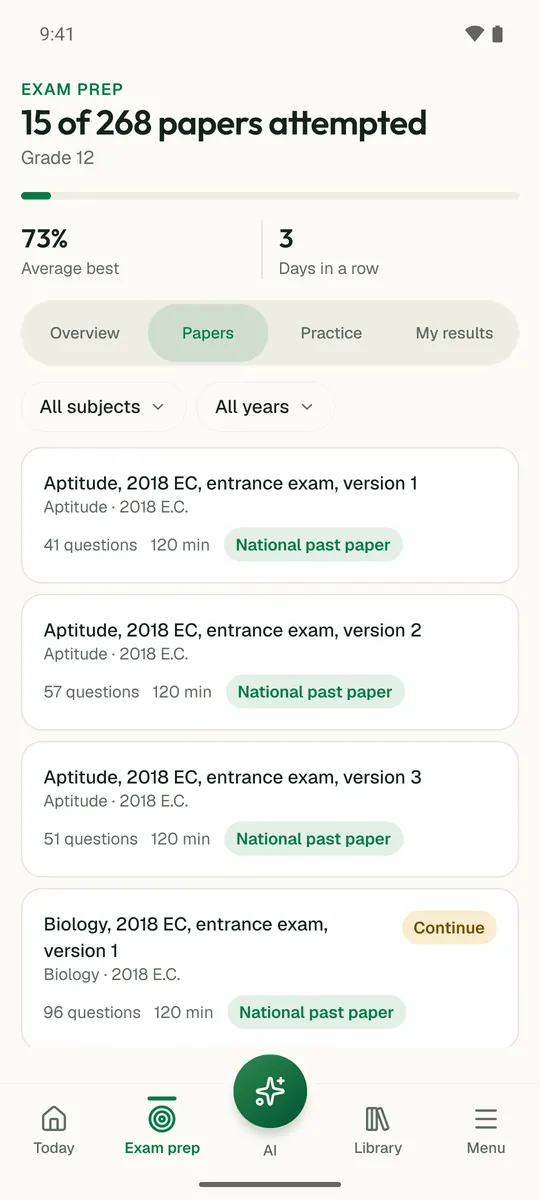
Temari turns this chapter into timed practice and marks it as you go, with an AI tutor to explain anything that did not land.

Start free

Temari.et is also an Android app, free on Google Play.

Sign inCreate your account