Grade 12 Mathematics unit 4
Sliding the objective line to the best corner
1:27
A short animated Temari explainer on Grade 12 Mathematics unit 4: Sliding the objective line to the best corner. Free to watch, no account needed.
Everything the explainer says
The explainer's words, part by part, as its captions show them.
How large can Z = x + y get?
Linear programming finds the largest or smallest value of a quantity, like Z = x + y, under rules called constraints.
Each rule cuts away part of the plane
x and y cannot be negative: only this quarter of the plane is allowed.
The rule x + 2y ≤ 4 keeps one side of its line, the half-plane below. x − y ≤ 1 keeps the half-plane above its line.
What is left obeys every rule: the feasible region. Its corners are where boundary lines cross.
Slide the objective line
Write the objective as y = −x + Z: a line crossing the y axis at Z.
Raise Z, and the line slides up, staying parallel.
At Z = 3, it touches the region only at the corner (2, 1).
Any higher, and it misses the region completely.
The best point is a corner
So the largest value is Z = 3. The other corners give only 0, 1 and 2.
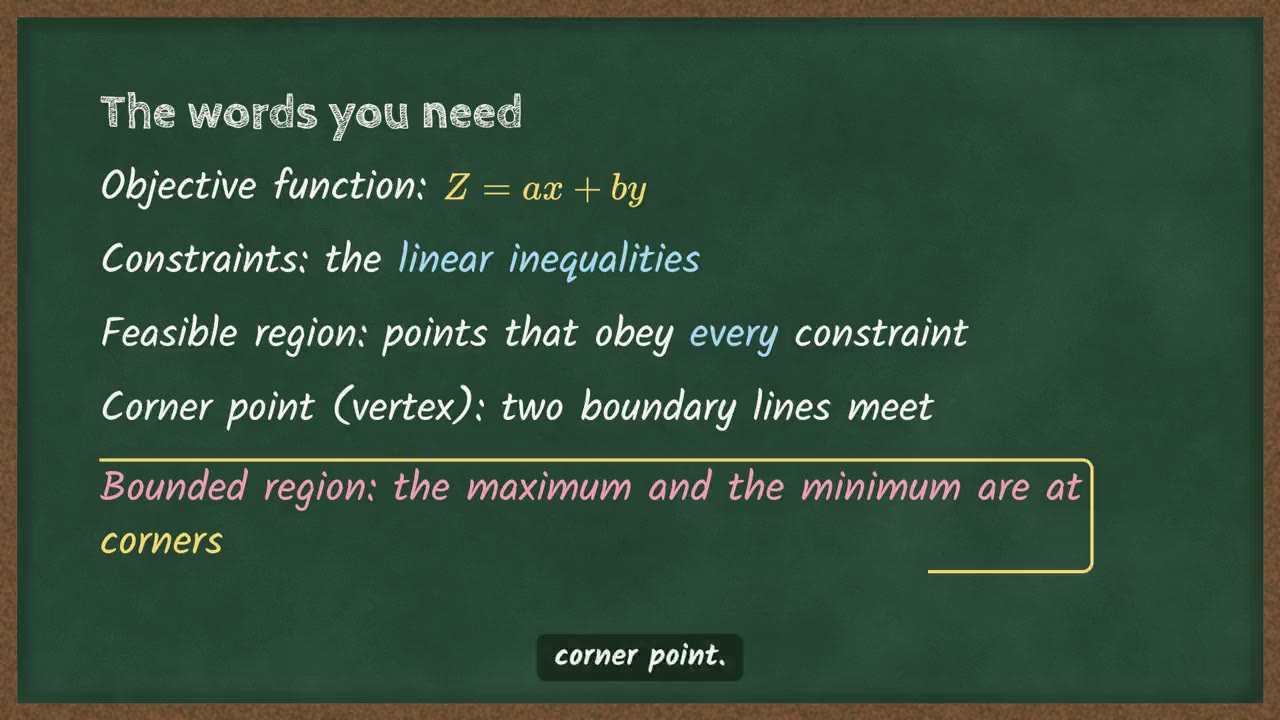
For a bounded region, closed in on every side, the largest and smallest Z always sit at corners.
Linear programming
Slide the objective line until it last touches the region: that point is a corner.
Save this one for your exam.
The full lesson on unit 4
Temari's longer video lesson on this chapter, with every word written out on its page.
 Linear programming: test every corner4 min
More on unit 4
The chapter's own page holds the rest of what Temari has on it, such as short notes and practice questions with their answers.
Open the unit 4 pagePractise this unit in the app
Temari turns this chapter into timed practice and marks it as you go, with an AI tutor to explain anything that did not land.
Start free
Temari.et is also an Android app, free on Google Play.

