Grade 12 Physics unit 5
Why a diode lets current through one way
1:29 · Explainer 1 of 2 on unit 5
A short animated Temari explainer on Grade 12 Physics unit 5: Why a diode lets current through one way. Every word it says is written out under the video.
Everything the explainer says
The explainer's words, part by part, as its captions show them.
Join P to N
A diode is a P-type semiconductor joined to an N-type one.
N has extra electrons that can move.
P has holes, missing electrons that act as positive charges.
At the join, electrons cross over and fill holes, leaving charged ions.
This thin layer, with very few mobile charges, is the depletion region.
Forward bias
Connect a battery, positive to P and negative to N: this is forward bias.
The battery pushes electrons and holes toward the join.
The depletion region turns very thin, the resistance is low, and a large current flows.
Reverse bias
Turn the battery round, negative on P: this is reverse bias.
Electrons and holes are pulled away from the join.
The depletion region widens, the resistance is high, and almost no current flows.
Current against voltage
In forward bias, the current stays very low until about 0.7 V for silicon, the cut-in voltage.
Past it, the current rises steeply.
In reverse bias, only a tiny leakage current flows.
P-N junction diode
Forward bias lets current through, and reverse bias blocks it.
Save this one for your exam.
The full lesson on unit 5
Temari's longer video lesson on this chapter, with every word written out on its page.
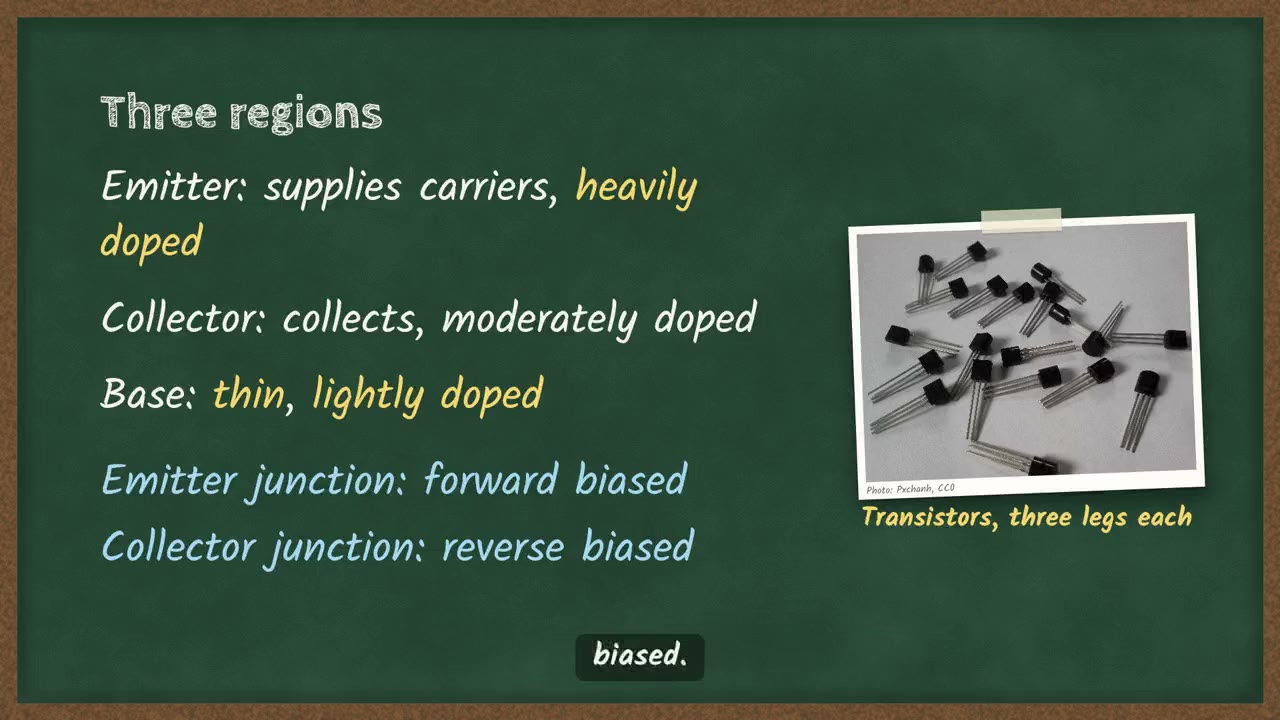 A transistor's three currents and its gain4 min
More explainers on unit 5
More on unit 5
The chapter's own page holds the rest of what Temari has on it, such as short notes and practice questions with their answers.
Open the unit 5 pagePractise this unit in the app
Temari turns this chapter into timed practice and marks it as you go, with an AI tutor to explain anything that did not land.
Start free
Temari.et is also an Android app, free on Google Play.

