Grade 10 Chemistry unit 1
How adding whole molecules balances an equation
1:20 · Explainer 1 of 2 on unit 1
A short animated Temari explainer on Grade 10 Chemistry unit 1: How adding whole molecules balances an equation. Free to watch, no account needed.
Everything the explainer says
The explainer's words, part by part, as its captions show them.
Count the atoms on each side
Nitrogen and hydrogen react to make ammonia.
Count the atoms on each side.
The left has two nitrogen atoms and two hydrogen atoms.
The right has one nitrogen atom, but three hydrogen atoms.
Atoms are neither created nor destroyed, so this is not balanced yet.
Write a number in front
Never change the small number inside a formula: NH₃ is ammonia.
Instead, write a number in front, called a coefficient.
2NH₃ means two whole molecules.
Balance one element at a time
Nitrogen first: put a two in front of ammonia.
Now nitrogen matches, but the right has six hydrogen atoms and the left only two.
So put a three in front of hydrogen.
Six hydrogen atoms on each side, and it is balanced.
Every atom finds a place
Watch the molecules on the left break apart.
Every atom moves across into an ammonia molecule.
None is left over, and none is missing.
That is the law of conservation of mass.
Balancing equations
Balance with coefficients until every kind of atom matches on both sides.
Save this one for revision.
The full lesson on unit 1
Temari's longer video lesson on this chapter, with every word written out on its page.
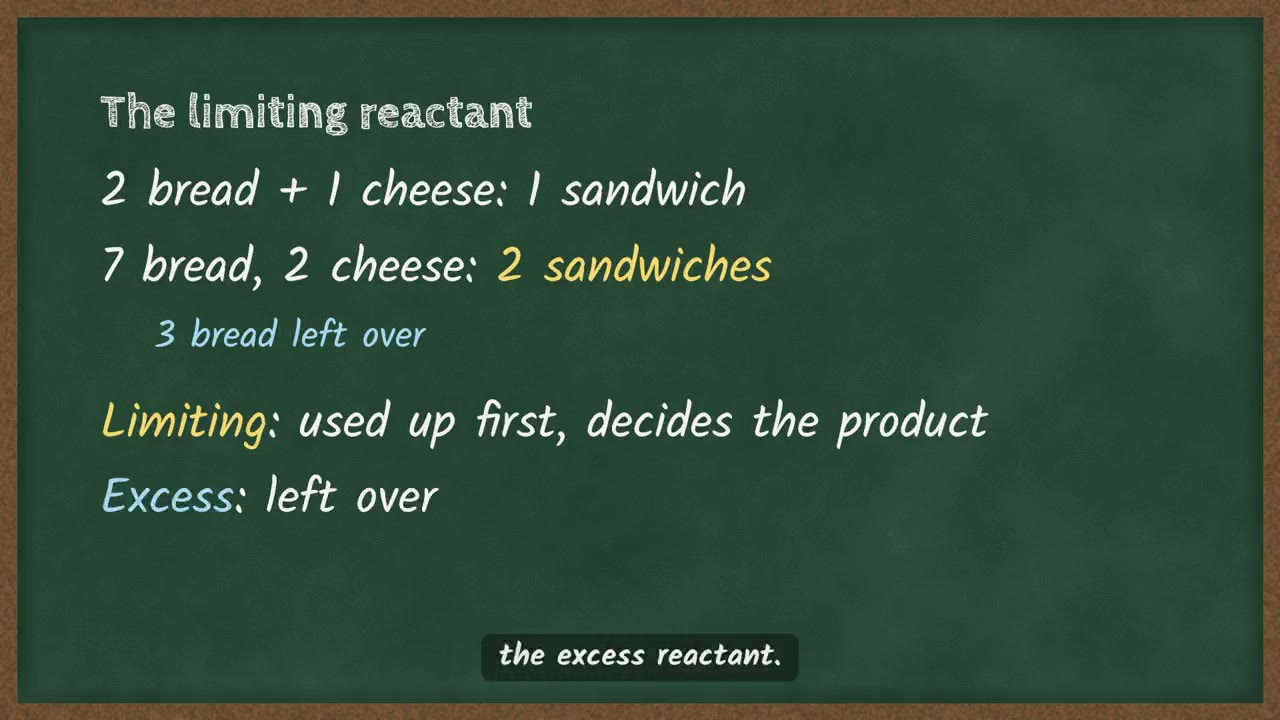 Which reactant runs out first?4 min
More explainers on unit 1
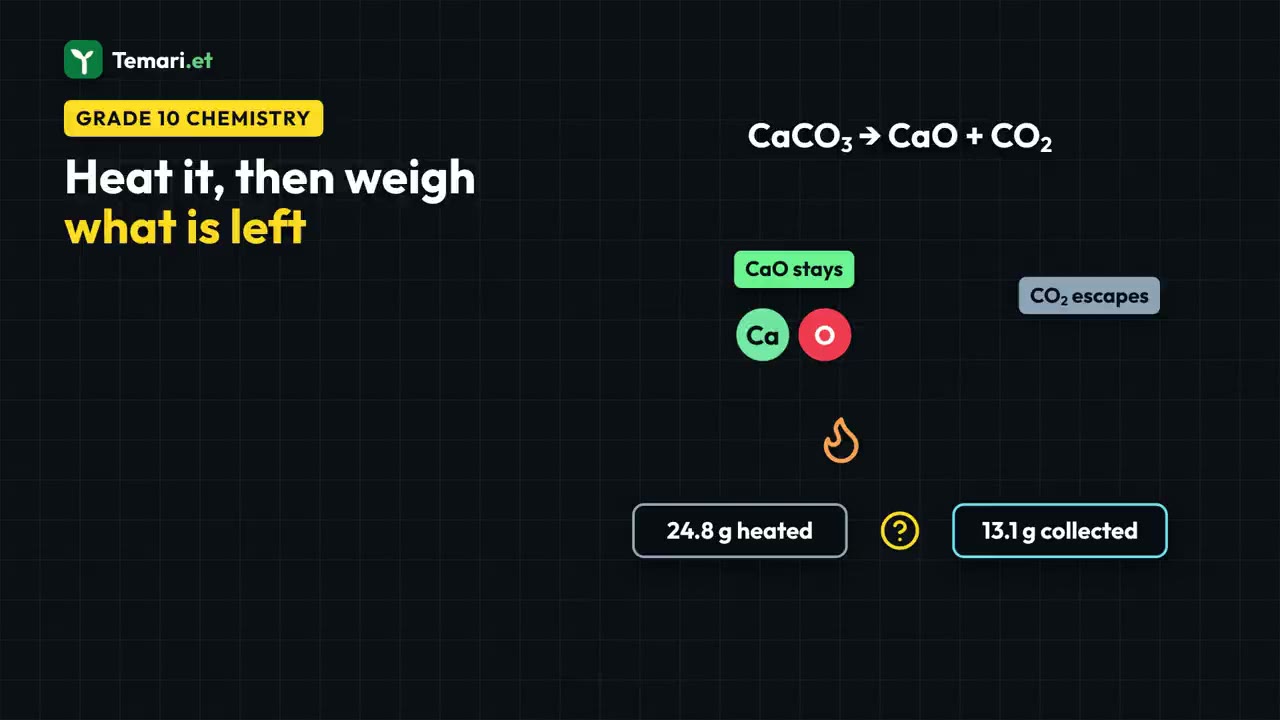
More on unit 1
The chapter's own page holds the rest of what Temari has on it, such as short notes and practice questions with their answers.
Open the unit 1 pagePractise this unit in the app
Temari turns this chapter into timed practice and marks it as you go, with an AI tutor to explain anything that did not land.
Start free
Temari.et is also an Android app, free on Google Play.

