Grade 10 Chemistry unit 1
How close a reaction comes to the most it could make
1:23 · Explainer 2 of 2 on unit 1
A short animated Temari explainer on Grade 10 Chemistry unit 1: How close a reaction comes to the most it could make. Free to watch, no account needed.
Everything the explainer says
The explainer's words, part by part, as its captions show them.
Heat it, then weigh what is left
Heat calcium carbonate, and it breaks down into calcium oxide and carbon dioxide.
The gas escapes, and calcium oxide stays behind.
From 24.8 grams, you collect 13.1 grams of calcium oxide.
Work out the most it could make
The equation says one mole gives one mole, so 100 grams of calcium carbonate give 56 grams of calcium oxide.
Then 24.8 grams can give at most about 13.9 grams.
This calculated amount is the theoretical yield.
Compare it with what you collected
The 13.1 grams you collected is the actual yield.
Percentage yield is actual yield over theoretical yield, times 100.
13.1 over 13.9, times 100, is about 94 percent.
Why it falls short
Many reactions do not reach 100 percent.
Some stop early, side reactions make unwanted products, and some product is lost as it is collected.
So the actual yield is usually less than the theoretical yield.
Percentage yield
Percentage yield is actual over theoretical, times 100.
Save this one for revision.
The full lesson on unit 1
Temari's longer video lesson on this chapter, with every word written out on its page.
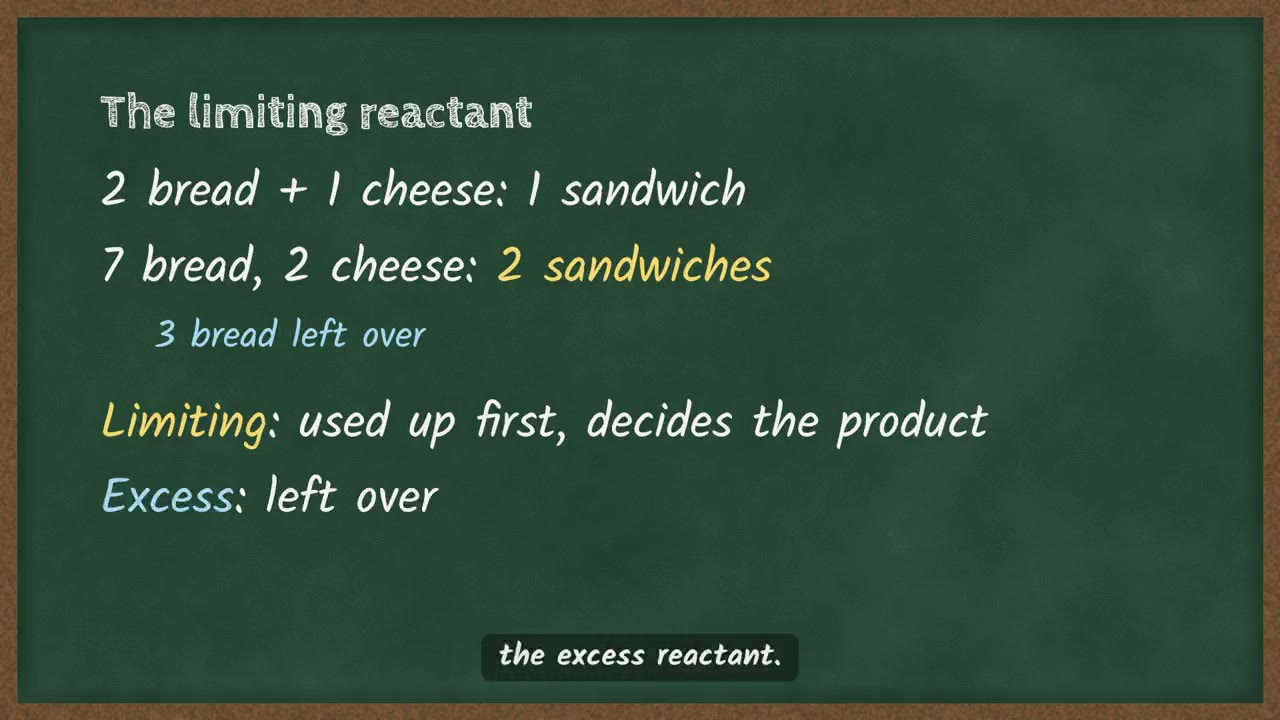 Which reactant runs out first?4 min
More explainers on unit 1
More on unit 1
The chapter's own page holds the rest of what Temari has on it, such as short notes and practice questions with their answers.
Open the unit 1 pagePractise this unit in the app
Temari turns this chapter into timed practice and marks it as you go, with an AI tutor to explain anything that did not land.
Start free
Temari.et is also an Android app, free on Google Play.

