Grade 10 Chemistry unit 5
How liquid air gives nitrogen and oxygen
1:18 · Explainer 1 of 2 on unit 5
A short animated Temari explainer on Grade 10 Chemistry unit 5: How liquid air gives nitrogen and oxygen. Every word it says is written out under the video.
Everything the explainer says
The explainer's words, part by part, as its captions show them.
Air is a mixture of gases
Air is a mixture of gases.
About four fifths is nitrogen, and one fifth is oxygen.
There is a little argon, water vapour and carbon dioxide too.
Squeezed and cooled, air turns liquid
The air is filtered, squeezed under high pressure and cooled.
Water vapour and carbon dioxide turn solid first, and are removed.
Cool it further, and the rest condenses into a pale-blue liquid.
The lowest boiling point leaves first
Now the liquid air warms slowly in a tall column.
Nitrogen boils lowest, at −196 °C, so it boils off first, into steel cylinders.
Argon follows at −186 °C.
Oxygen boils at −183 °C, so it is left behind as a blue liquid.
One liquid, two pure gases
This is fractional distillation: each gas leaves at its own boiling point.
So one liquid gives two pure gases, nitrogen and oxygen.
Most nitrogen becomes ammonia for fertiliser, and oxygen helps fuels burn.
Fractional distillation of air
The lowest boiling point leaves first.
Save this one for revision.
The full lesson on unit 5
Temari's longer video lesson on this chapter, with every word written out on its page.
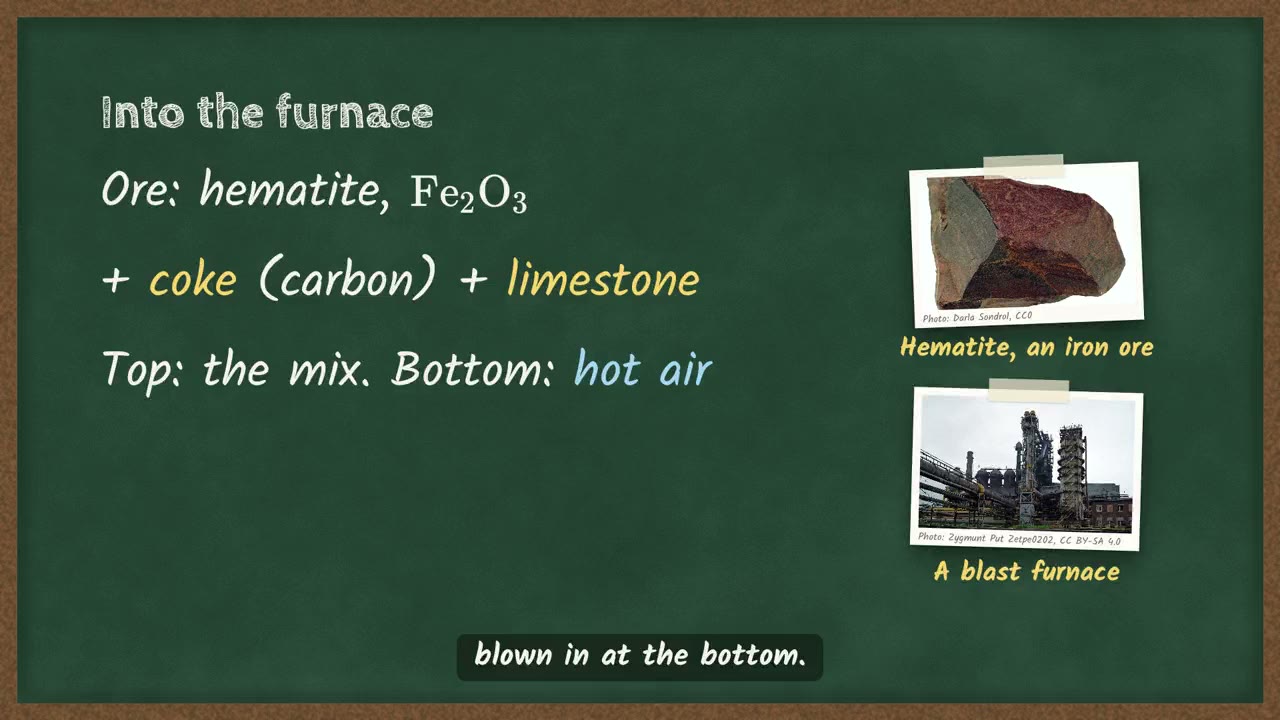 Iron from rock: the blast furnace4 min
More explainers on unit 5
More on unit 5
The chapter's own page holds the rest of what Temari has on it, such as short notes and practice questions with their answers.
Open the unit 5 pagePractise this unit in the app
Temari turns this chapter into timed practice and marks it as you go, with an AI tutor to explain anything that did not land.
Start free
Temari.et is also an Android app, free on Google Play.

