Grade 11 Chemistry unit 3
Equal volumes of gas hold equal numbers of molecules
1:29 · Explainer 2 of 2 on unit 3
A short animated Temari explainer on Grade 11 Chemistry unit 3: Equal volumes of gas hold equal numbers of molecules. Free to watch, no account needed.
Everything the explainer says
The explainer's words, part by part, as its captions show them.
More molecules push the piston higher
Here is a gas under a sliding piston, at one temperature and one pressure.
Pump in more molecules, and the piston climbs.
Double the molecules, and the volume doubles.
So at constant temperature and pressure, volume is directly proportional to the number of moles: Avogadro's law.
Equal volumes, equal numbers of molecules
Now light hydrogen and heavy carbon dioxide fill equal volumes, at the same temperature and pressure.
Count the molecules: the numbers match.
Size hardly matters, because molecules fill almost none of the space.
At STP, one mole of any gas fills 22.4 L.
Fewer moles, a smaller volume
12.2 L of oxygen holds 0.50 mol.
Turn it into ozone: every three oxygen molecules become two ozone molecules.
So the moles fall to 0.33 mol, two thirds as many.
The volume falls by the same share, to 8.0 L.
Which law is this?
An exam asked: equal volumes of different gases, at the same temperature and pressure, contain equal numbers of molecules. Which law is that?
It is Avogadro's law.
Avogadro's law
More moles of gas, more volume.
Save this one for revision.
The full lesson on unit 3
Temari's longer video lesson on this chapter, with every word written out on its page.
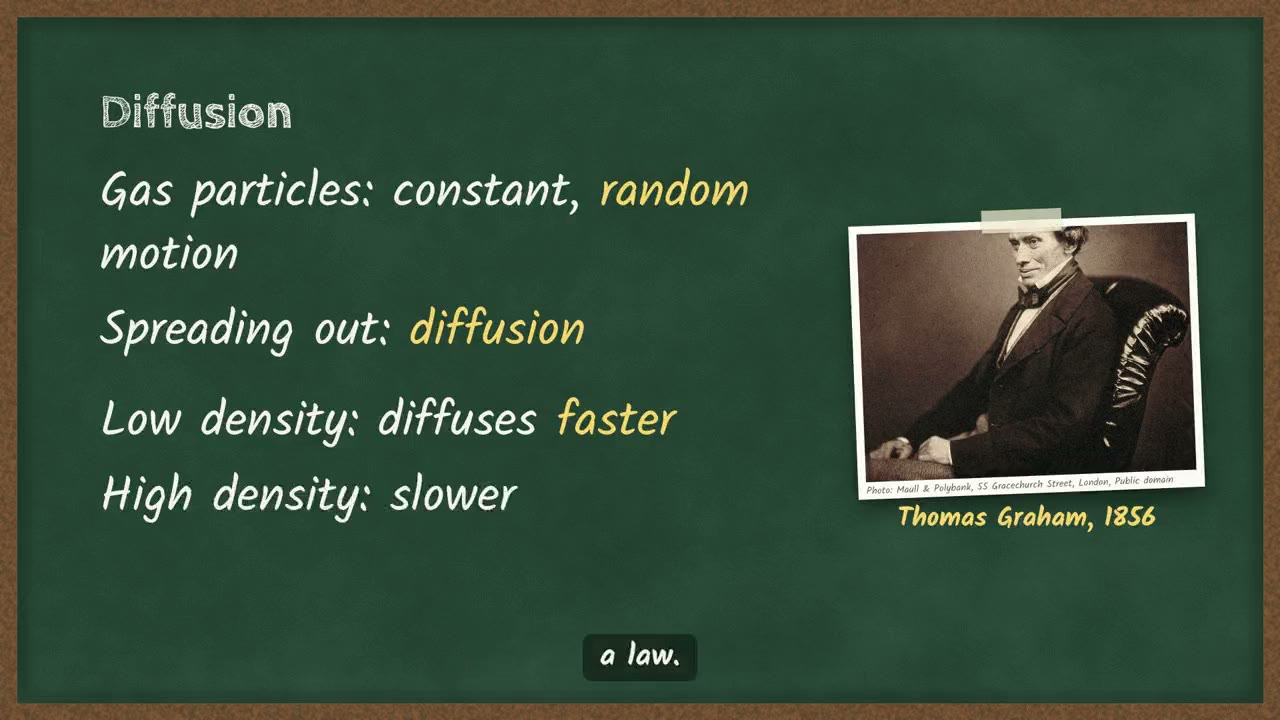 Graham's law: why light gases spread faster4 min
More explainers on unit 3
More on unit 3
The chapter's own page holds the rest of what Temari has on it, such as short notes and practice questions with their answers.
Open the unit 3 pagePractise this unit in the app
Temari turns this chapter into timed practice and marks it as you go, with an AI tutor to explain anything that did not land.
Start free
Temari.et is also an Android app, free on Google Play.

