
Grade 12 results are out. Where to check yours

Unit notes and practice questions

Grade 11 History unit 8: Political, social and economic processes in Ethiopia, mid 16th to mid-19th century

Everything here is for unit 8 of the Grade 11 History textbook: what the chapter covers, the short notes, practice questions with their answers, and the lesson video where one exists.

Get it on Google Play
3
Cards
10
Practice questions on unit 8
202–237
The textbook pages for unit 8

Start here

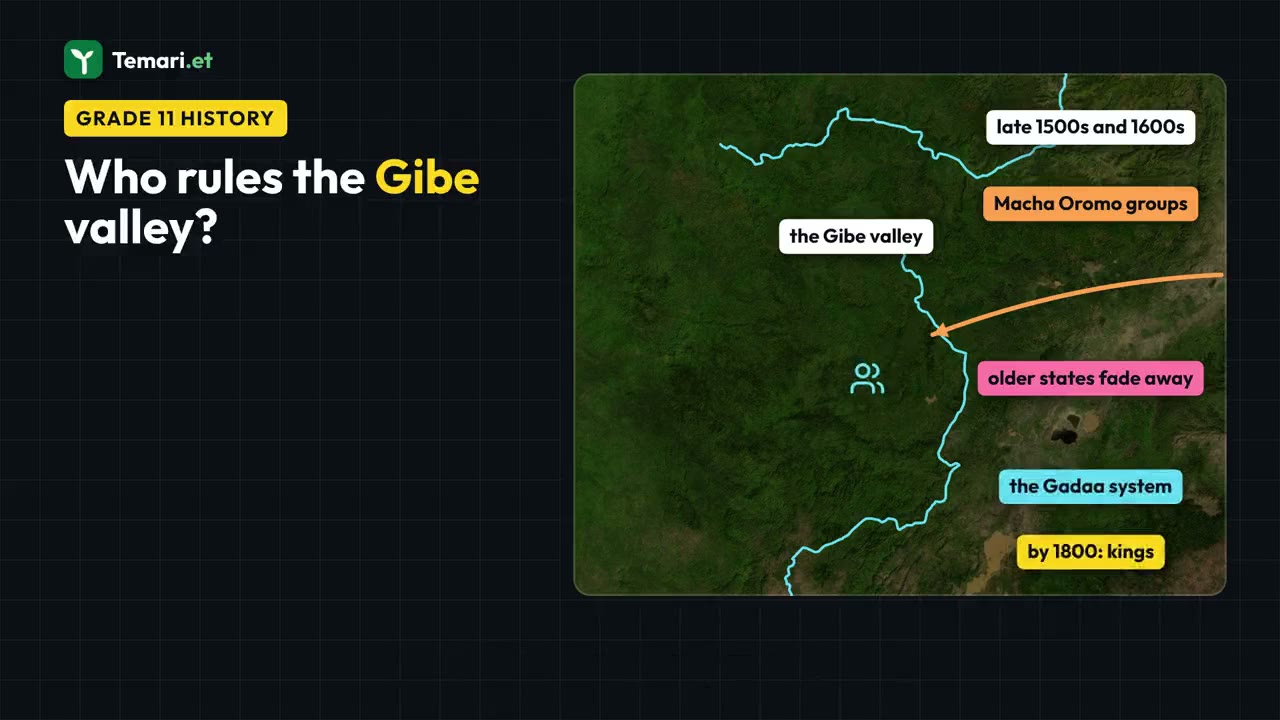
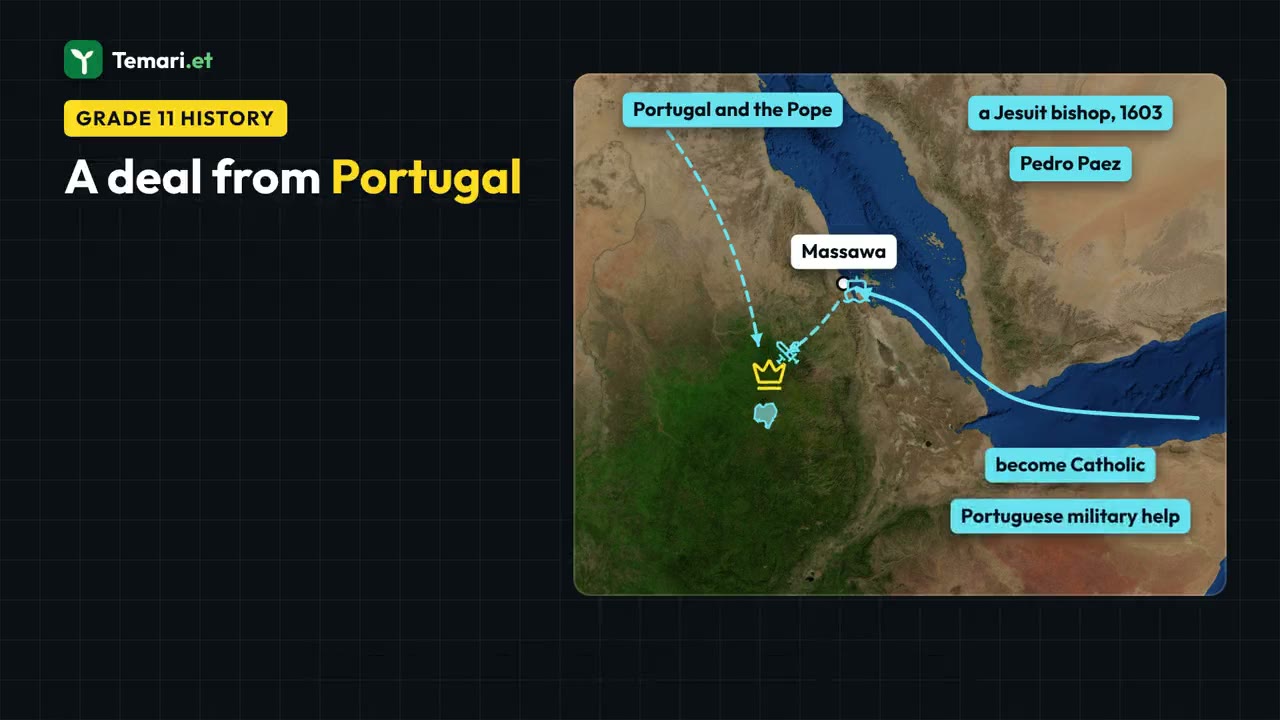
The Temari lesson on unit 8

A short video lesson on this chapter, made by Temari. It loads only when you press play.

Kings without power: the Zemene Mesafint · 4 min · 2 past exam questions worked through

Parts of the lesson

Tap a part to play the lesson from there.

The lesson on its own page, with every word written out

Short explainers

Short explainers on unit 8

Animated videos of a minute or two, each on one idea from this chapter. Tap one to watch it on its own page, with every word written out.

What unit 8 covers

  1. 1.Peoples and States of Southern, Western and Eastern Ethiopia

Short notes for unit 8

The cards filed under this chapter on the Grade 11 History page. Open one at a time.

When you use it

Use when summarizing how Jesuit missionary activity led to civil war and the subsequent diplomatic isolation of the Christian Kingdom.

Watch out

Susinyos declared Catholicism the official religion in 1622 and abdicated in 1632. His successor Fasiledes reversed this, restored Orthodoxy, expelled the Jesuits, and started the closed door policy.

Drafted from Grade 11 History, page 218 onwards, then checked twice before it went up

DateBattleDefeated LeaderSignificance
November 1852Gur AmbaDejjazmach Goshu ZewdeDefeat of the ruler of Gojjam
April 1853Gorgora BichenFour vassals of Ras Ali IICrushed the coalition forces of Yejju
June 1853AyshalRas Ali II (Rasbitweded)Ended the political dominance of the Yejju dynasty
1855DeresgeDejjazmach WubePaved the way for Kasa coronation as Tewodros II

When you use it

Use when recalling the chronological sequence of battles by which Kasa Hailu defeated regional warlords to end the Zemene Mesafint.

Watch out

The Battle of Ayshal in June 1853 defeated Ras Ali II, whereas Deresge in 1855 defeated Dejjazmach Wube, leading directly to the coronation of Tewodros II.

Drafted from Grade 11 History, page 218 onwards, then checked twice before it went up
StateKey RulerCapitalDistinction
Limmu-EnnaryaBofo (Abba Gomol I)SaqqaEarliest Gibe state formed around 1800
GummaOncho JilchaNot specifiedFormed around 1810 through military conquest
GommaAbba MannoNot specifiedEarliest Gibe state to adopt Islam in the 1830s
Jimma-KakkaSanna (Abba Jiffar I)HirmataMajor commercial rival of Limmu-Ennarya
GeraTullu GunjiNot specifiedFounded in the mid 1830s

When you use it

Use when identifying the founders, capitals, or specific historical features of the monarchical states that emerged in the Gibe basin.

Watch out

Limmu-Ennarya was the earliest Gibe state to form around 1800, whereas Gomma was the earliest to adopt Islam in the 1830s.

Drafted from Grade 11 History, page 218 onwards, then checked twice before it went up

Practice questions on unit 8

10 multiple-choice questions written against this chapter, each with its answer and the reason. Try one before you open the answer.

Question 1

Which of the five Gibe monarchical states was the earliest to be formed around 1800 on the medieval kingdom of Ennarya?

  1. A.Jimma-Kakka
  2. B.Limmu-Ennarya
  3. C.Gera
  4. D.Gomma
Show the answer and why

Answer: B Limmu-Ennarya

Why

The textbook states that the earliest of the Gibe states was Limmu-Ennarya, which was established around 1800 by the Limmu branch of the Macha Oromo under its first king, Abba Gomol I.

Question 2

Who was the founder and first ruler of the independent local Harari dynasty established in 1647?

  1. A.Emir Nur ibn al-Wazir
  2. B.Emir Ali Dawud
  3. C.Mohammad Rauf Pasha
  4. D.Imam Ahmad
Show the answer and why

Answer: B Emir Ali Dawud

Why

The tributary relationship with Aussa was broken when a local Harari dynasty was established by Emir Ali Dawud (r. 1647-1662), who declared the independence of the Emirate of Harar.

Question 3

Which king of the Christian highland kingdom established Gondar as a permanent capital around 1636 and introduced the closed-door policy?

  1. A.Gelawdewos
  2. B.Susinyos
  3. C.Fasiledes
  4. D.Iyasu I
Show the answer and why

Answer: C Fasiledes

Why

King Fasiledes restored Orthodox Christianity in 1632, established Gondar as the permanent capital around 1636, expelled the Jesuits, and introduced the closed-door policy.

Question 4

Who was the first ruler of the Kingdom of Shewa to assume the title of Nigus (King)?

  1. A.Negasi Kirstos
  2. B.Meridazmach Amhayesus
  3. C.Wossenseged
  4. D.Sahle Selassie
Show the answer and why

Answer: D Sahle Selassie

Why

Sahle Selassie (r. 1813-1847) was the first Shewan ruler to take the royal title of Nigus, during whose reign the kingdom reached the peak of its power.

Question 5

In the traditional administrative system of the Anywaa people, what was the title of the village headman?

  1. A.Kwaari
  2. B.Nyiye
  3. C.Makaban
  4. D.Khor Muon
Show the answer and why

Answer: A Kwaari

Why

In the Anywaa indigenous administrative system, each village was ruled by a village headman called a Kwaari and a noble called a Nyiye.

Question 6

What was the name of the customary council of judges in the indigenous legal system of the Afar people?

  1. A.Shir
  2. B.Makabonto
  3. C.Afocha
  4. D.Yajoka
Show the answer and why

Answer: B Makabonto

Why

The Afar people had an indigenous court system known as Makabonto (council of judges), where an individual judge is called a Makaban.

Question 7

Which Abbaa Duulaa unified a number of Leeqaa families around Naqamtee and established his base at Wacha?

  1. A.Abbaa Duulaa Tulluu
  2. B.Moroda Bakaree
  3. C.Bakaree Godana
  4. D.Kumsa Moroda
Show the answer and why

Answer: C Bakaree Godana

Why

Bakaree Godana was the Abbaa Duulaa who unified Leeqaa families around Naqamtee and based his polity at Wacha, which became the nucleus of Naqamtee.

Question 8

What name was given to the political elite organized by Etege Mintiwab from her kinsmen to support her rule and that of her son, Iyasu II?

  1. A.Abegazoch
  2. B.Quaregnoch
  3. C.Makabonto
  4. D.Aboch
Show the answer and why

Answer: B Quaregnoch

Why

Etege Mintiwab came from Qwara and organized her relatives and kinsmen into a powerful political group known as the Quaregnoch.

Question 9

Which brother of King Susinyos was the first major royal convert to Catholicism in 1611 and represented the Catholics in public theological debates?

  1. A.Ras Welde Leul
  2. B.Ras Si'ile Kristos
  3. C.Bahire Negash Yeshaq
  4. D.Hamelmal
Show the answer and why

Answer: B Ras Si'ile Kristos

Why

Ras Si'ile Kristos was baptized into Catholicism in 1611 and actively defended Catholic doctrines during debates chaired by Susinyos. He was later executed when Fasiledes restored Orthodoxy.

Question 10

At which battle in June 1853 did Dejjazmach Kasa Hailu defeat the Yejju ruler and Rasbitweded, Ras Ali II?

  1. A.Battle of Gur Amba
  2. B.Battle of Gorgora Bichen
  3. C.Battle of Ayshal
  4. D.Battle of Deresge
Show the answer and why

Answer: C Battle of Ayshal

Why

Kasa Hailu defeated Dejjazmach Goshu at Gur Amba, four vassals at Gorgora Bichen, Ras Ali II at the Battle of Ayshal in June 1853, and Dejjazmach Wube at Deresge in 1855.

The app holds 12 questions on this unit, marked as you go. These are the first 10.

The textbook pages for unit 8

Unit 8 runs from page 202 to page 237 of the Ministry of Education edition.

Ministry of Education edition, English, 270 pages

Download the PDF

Practise this unit in the app

Temari turns this chapter into timed practice and marks it as you go, with an AI tutor to explain anything that did not land.

Start free

Temari.et is also an Android app, free on Google Play.

Sign inCreate your account