Grade 12 Biology unit 4
How a fossil's age is read from its atoms
1:27 · Explainer 3 of 3 on unit 4
A short animated Temari explainer on Grade 12 Biology unit 4: How a fossil's age is read from its atoms. Every word it says is written out under the video.
Everything the explainer says
The explainer's words, part by part, as its captions show them.
Deeper layers are older
Sedimentary rock is laid down in layers, one on top of another.
The oldest fossils lie in the lowest layers, and the newest lie nearest the surface.
That is relative dating. It says which is older, but not by how many years.
Radioactive atoms keep time
For the years, scientists measure radioactive atoms in the fossil, like carbon 14.
Each one decays into a nitrogen atom.
Half of them decay in one half-life, which for carbon 14 is 5,730 years.
Half, then half again
At time zero, all of it is still there.
After one half-life, half remains.
After two, a quarter remains.
After three, an eighth.
Each half-life, half of what is left decays.
Read the age off the curve
Plotted over time, the decay draws this curve.
Say a fossil holds a quarter of the carbon 14 a living thing has.
That is two half-lives, so the fossil is 11,460 years old.
Radiocarbon dating works for fossils up to 60,000 years old.
Radiometric dating
Each half-life halves the carbon 14, so what is left gives the age.
Save this one for your exam.
The full lesson on unit 4
Temari's longer video lesson on this chapter, with every word written out on its page.
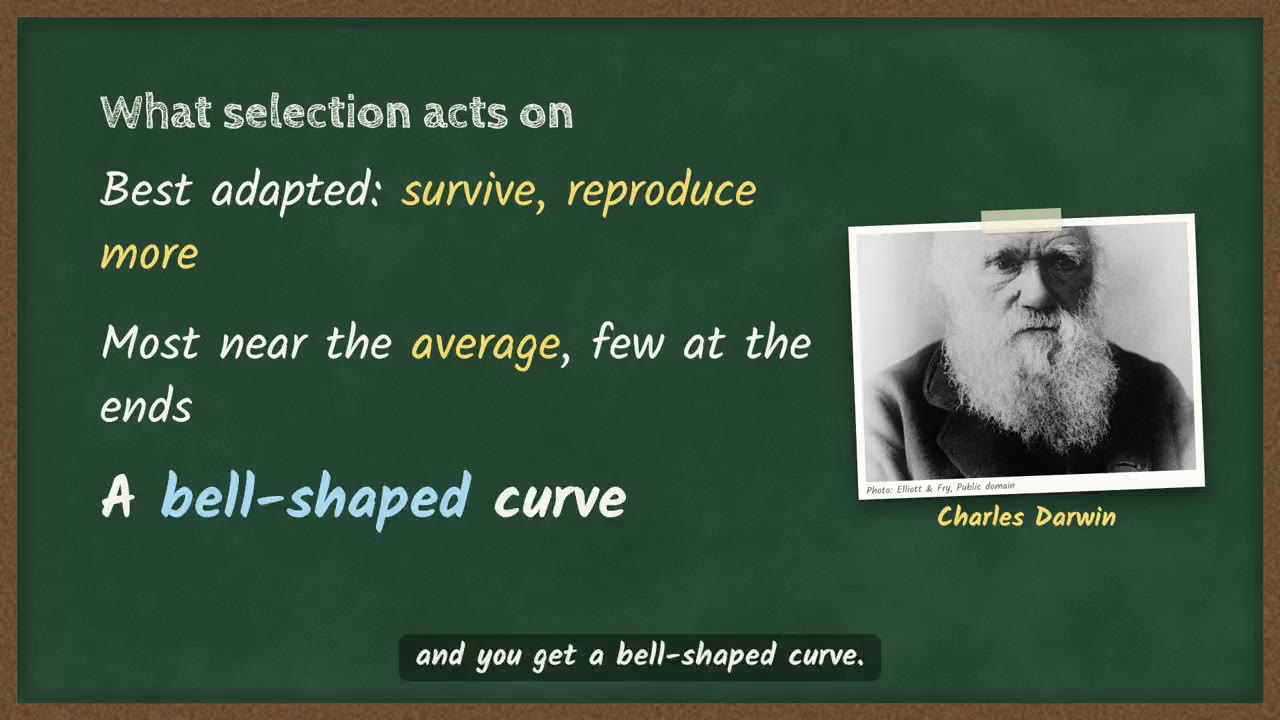 Three ways natural selection shapes a population4 min
More explainers on unit 4
More on unit 4
The chapter's own page holds the rest of what Temari has on it, such as short notes and practice questions with their answers.
Open the unit 4 pagePractise this unit in the app
Temari turns this chapter into timed practice and marks it as you go, with an AI tutor to explain anything that did not land.
Start free
Temari.et is also an Android app, free on Google Play.

