Grade 12 Chemistry unit 3
Nitric acid from ammonia: the Ostwald process
1:12 · Explainer 1 of 2 on unit 3
A short animated Temari explainer on Grade 12 Chemistry unit 3: Nitric acid from ammonia: the Ostwald process. Free to watch, no account needed.
Everything the explainer says
The explainer's words, part by part, as its captions show them.
From ammonia to nitric acid
Nitric acid is made from ammonia, in three steps called the Ostwald process.
Ammonia and oxygen go in at one end, and nitric acid comes out at the other.
Step 1: burn it over platinum
First, ammonia burns in excess oxygen over a platinum catalyst, at about 850 °C and 5 atm.
Out come nitric oxide, NO, and water.
Step 2: more air makes NO₂
Next, the nitric oxide moves on, and more air is added.
The air cools the gas, and its oxygen turns nitric oxide into nitrogen dioxide, NO₂, a brown gas.
Step 3: into warm water
Last, the nitrogen dioxide is bubbled into warm water.
Three molecules of it give two of nitric acid, and one of nitric oxide.
That nitric oxide goes back to step two, and is used again.
Ostwald process
Burn ammonia over platinum, oxidize the nitric oxide with air, then dissolve the nitrogen dioxide in water.
Save this one for your exam.
The full lesson on unit 3
Temari's longer video lesson on this chapter, with every word written out on its page.
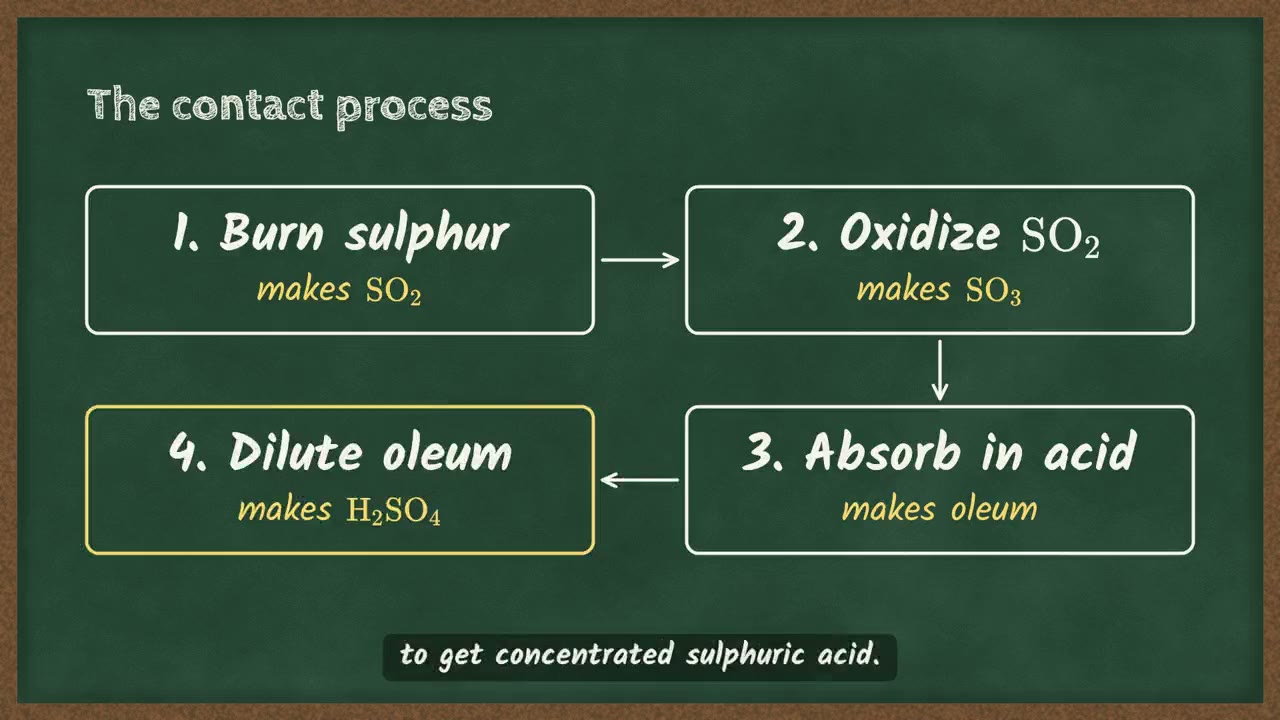 How sulphuric acid is made: the contact process4 min
More explainers on unit 3
More on unit 3
The chapter's own page holds the rest of what Temari has on it, such as short notes and practice questions with their answers.
Open the unit 3 pagePractise this unit in the app
Temari turns this chapter into timed practice and marks it as you go, with an AI tutor to explain anything that did not land.
Start free
Temari.et is also an Android app, free on Google Play.

