Grade 12 Chemistry unit 3
Inside the cement kiln: from limestone to clinker
1:16 · Explainer 2 of 2 on unit 3
A short animated Temari explainer on Grade 12 Chemistry unit 3: Inside the cement kiln: from limestone to clinker. Free to watch, no account needed.
Everything the explainer says
The explainer's words, part by part, as its captions show them.
How a kiln makes cement
Cement is made by heating limestone and clay in a long kiln.
The mix goes in at the upper end, and moves slowly down to the lower end, where it is hottest.
Upper part: the mix dries
In the upper part of the kiln, the mix loses all its moisture.
The water is driven off, and a dry mix moves on.
Middle: limestone breaks down
In the middle part, the limestone breaks down.
Calcium carbonate turns into calcium oxide, and carbon dioxide gas escapes.
Lower end: clinker forms
At the lower end, the mix reaches about 1600 °C.
There, calcium oxide joins with silica and alumina, to form calcium silicates and aluminates.
Together they make hard lumps, called clinker.
Grind it with gypsum
The clinker is cooled, then ground to a fine powder with two to three percent gypsum.
That powder is cement. The gypsum slows down its setting, so the cement hardens properly.
Making cement
In the kiln the mix dries, limestone breaks down, and clinker forms. Grind it with gypsum to make cement.
Save this one for your exam.
The full lesson on unit 3
Temari's longer video lesson on this chapter, with every word written out on its page.
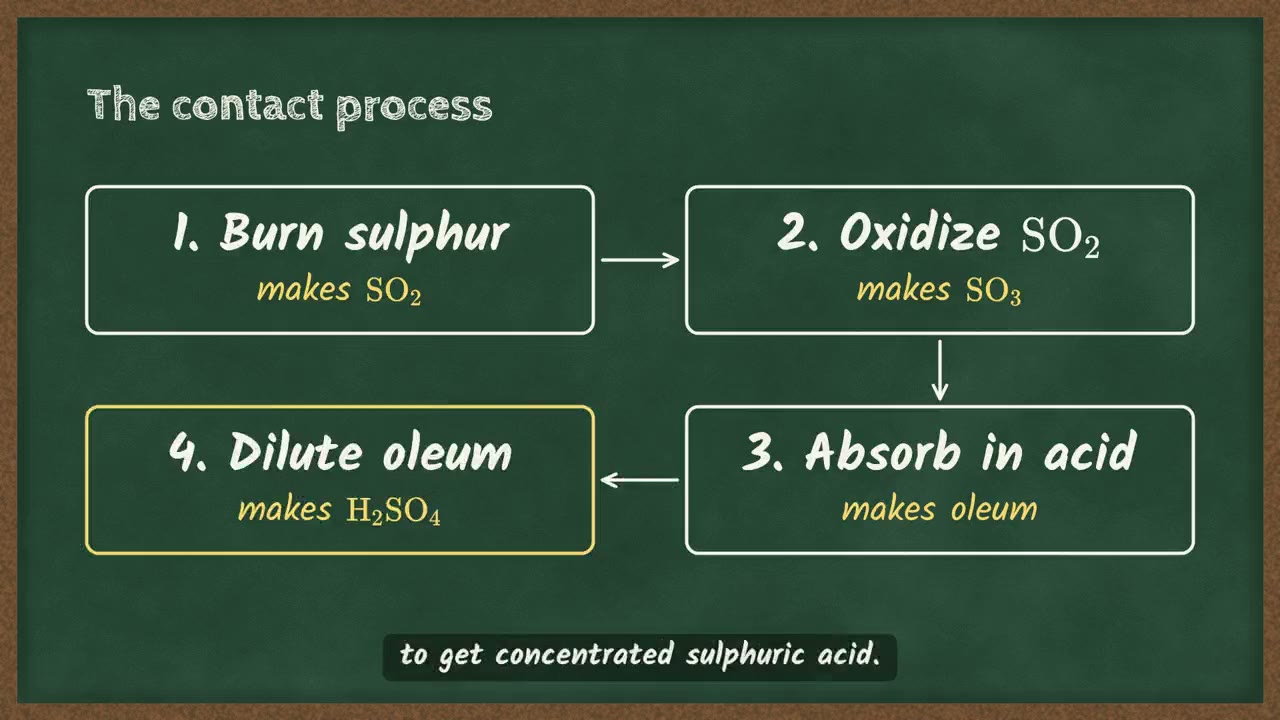 How sulphuric acid is made: the contact process4 min
More explainers on unit 3
More on unit 3
The chapter's own page holds the rest of what Temari has on it, such as short notes and practice questions with their answers.
Open the unit 3 pagePractise this unit in the app
Temari turns this chapter into timed practice and marks it as you go, with an AI tutor to explain anything that did not land.
Start free
Temari.et is also an Android app, free on Google Play.

