
Grade 12 results are out. Where to check yours

Unit notes and practice questions

Grade 12 History unit 3: Social, Economic and Political Developments in Ethiopia, Mid, 19th C. to 1941

Everything here is for unit 3 of the Grade 12 History textbook: what the chapter covers, the short notes, practice questions with their answers, and the lesson video where one exists.

Get it on Google Play
4
Cards
10
Practice questions on unit 3
46–91
The textbook pages for unit 3

Start here

The Temari lesson on unit 3

A short video lesson on this chapter, made by Temari. It loads only when you press play.

From Wuchale to Adwa · 3 min · 2 past exam questions worked through

Parts of the lesson

Tap a part to play the lesson from there.

The lesson on its own page, with every word written out

Short explainers

Short explainers on unit 3

Animated videos of a minute or two, each on one idea from this chapter. Tap one to watch it on its own page, with every word written out.

Short notes for unit 3

The cards filed under this chapter on the Grade 12 History page. Open one at a time.

DateEvent
1935Italy launched a war of aggression against Ethiopia.
Later in the warEthiopian forces lost conventional battles but waged a nationwide struggle that confined Italian rule to the major urban centers.
June 1940Italy declared war on Britain and France, and the British then intervened in the war of liberation against the Italians.
1941Combined British and Ethiopian patriot forces defeated the Italians and expelled them from Ethiopia.

When you use it

Use this when a question asks how Italy's war against Ethiopia unfolded or how Ethiopia was liberated in 1941.

Watch out

Italian rule was confined to the major urban centers, not the whole country. Do not write that Italy controlled all of Ethiopia from 1935 to 1941.

Drafted from Grade 12 History, pages 92-119, then checked twice before it went up

DateBattleWinner
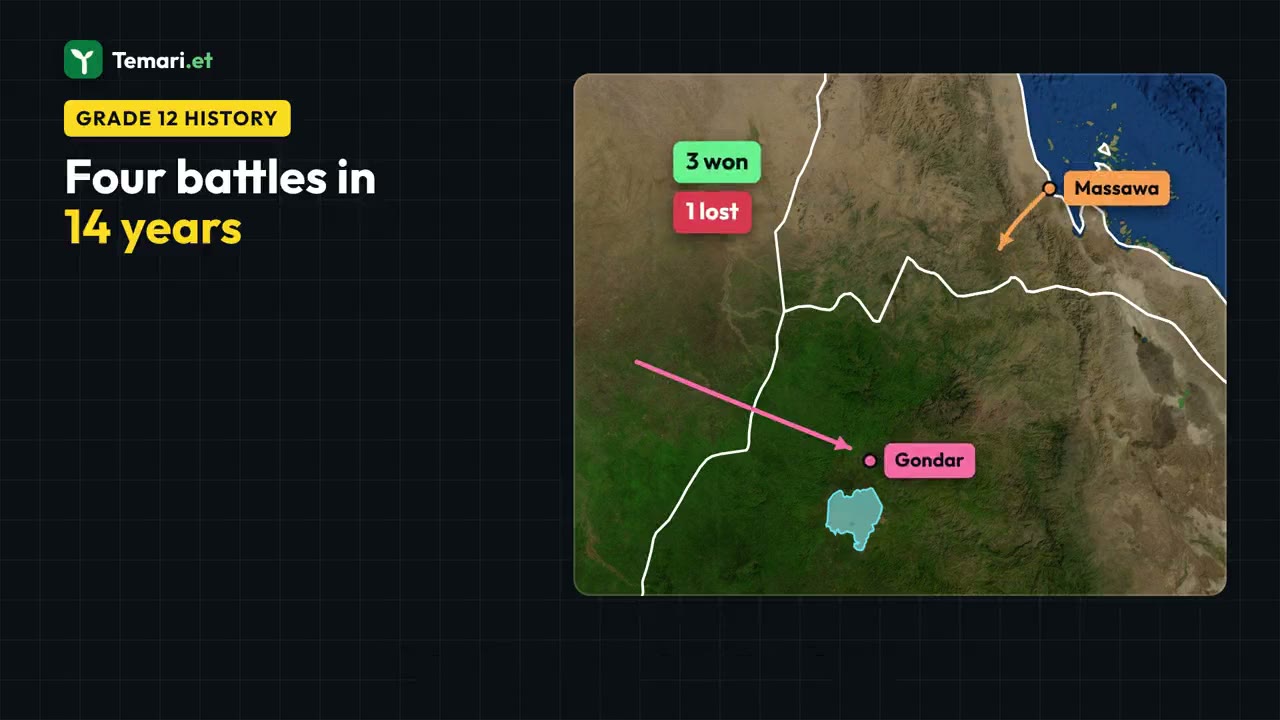
November 1852GurambaDejach Kassa
April 1853Gorgora BichenDejach Kassa
29 June 1853AyshalDejach Kassa
February 1855DeresgeKassa Hailu (Tewodros II)

When you use it

Reach for this when asked how Kassa Hailu rose to power and when the Zemene Mesafint came to an end.

Watch out

The battle of Ayshal (29 June 1853) ended Worashe rule but did not end the Zemene Mesafint. Only the battle of Deresge (February 1855), against Dejach Wube, brought the period to an end.

Drafted from Grade 12 History, pages 46-91, then checked twice before it went up

PhaseDate
Battle of Ambalage7 December 1895
Siege of Mekelle7 to 21 January 1896
Final battle of Adwa1 March 1896

When you use it

Reach for this when asked how long the Adwa campaign lasted or on which date a particular battle of it took place.

Watch out

Adwa was not a single day's battle; it was a campaign of three phases. 1 March 1896 is only the final battle, and Ambalage came first in December 1895. The peace treaty signed on 26 October 1896 is a separate event.

Drafted from Grade 12 History, pages 46-91, then checked twice before it went up

When you use it

Reach for this when asked why Italy claimed a protectorate over Ethiopia and what led to the Battle of Adwa.

Watch out

Do not write Article 17 as one agreed text. The Amharic version said Menilek may use Italian services in foreign dealings; the Italian version made it mandatory that all foreign contacts go through Italy. Menilek rejected the Italian version in February 1893.

Drafted from Grade 12 History, pages 46-91, then checked twice before it went up

Practice questions on unit 3

10 multiple-choice questions written against this chapter, each with its answer and the reason. Try one before you open the answer.

Question 1

Which of the following was a well-known slave auction market in Gojjam during the nineteenth century?

  1. A.Yejjube
  2. B.Bonga
  3. C.Assendabo
  4. D.Ankober
Show the answer and why

Answer: A Yejjube

Why

The textbook states that the well-known slave auction markets were Yejjube in Gojjam and Abdul Rasul near Aleyu Amba.

Question 2

Which battle fought in February 1855 marked the end of the Zemene Mesafint?

  1. A.Battle of Guramba
  2. B.Battle of Ayshal
  3. C.Battle of Deresge
  4. D.Battle of Gorgora Bichen
Show the answer and why

Answer: C Battle of Deresge

Why

At the Battle of Deresge in February 1855, Kassa Hailu defeated Dejach Wube and was crowned Emperor Tewodros II, King of Kings of Ethiopia, ending the Zemene Mesafint.

Question 3

Under the Hewett (Adwa) Treaty of 1884, what did Emperor Yohannis IV agree to do?

  1. A.Allow Italy to take control of Massawa
  2. B.Facilitate the safe evacuation of Egyptian troops trapped in eastern Sudan
  3. C.Pay war damages to the British government
  4. D.Hand over the province of Bogos to Great Britain
Show the answer and why

Answer: B Facilitate the safe evacuation of Egyptian troops trapped in eastern Sudan

Why

In the Hewett Treaty signed in 1884 at Adwa, Emperor Yohannis IV agreed to facilitate the safe evacuation of Egyptian troops trapped in eastern Sudan through Ethiopia.

Question 4

During the Adwa campaign, how did the Ethiopian forces under Empress Taytu force the Italian garrison at Mekelle to surrender?

  1. A.By cutting off their water supply from the stream
  2. B.By using the Sevastopol mortar to destroy the fort walls
  3. C.By conducting a surprise cavalry charge at night
  4. D.By signing an immediate peace treaty
Show the answer and why

Answer: A By cutting off their water supply from the stream

Why

During the siege of Mekelle, Empress Taytu and her forces took control of the stream where the Italians fetched water, forcing them to surrender.

Question 5

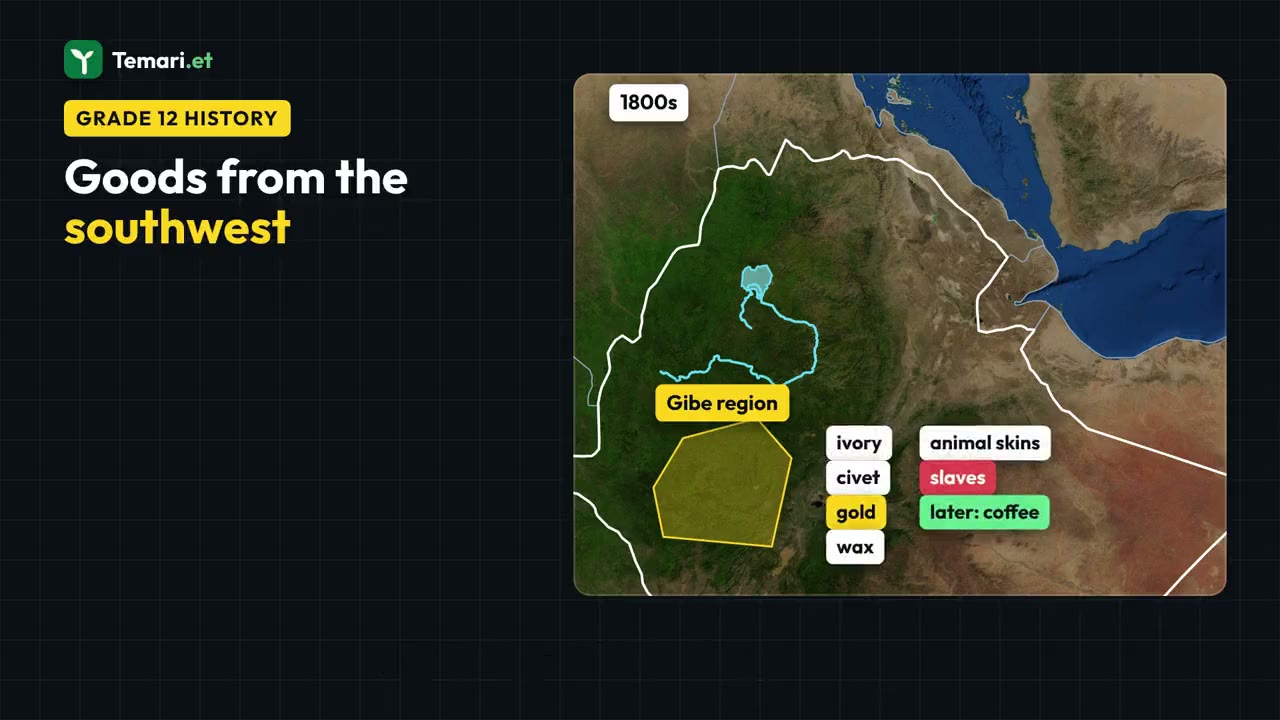
Which group of Muslim merchants dominated local trade in the Gibe region and competed with the Jabarti during the nineteenth century?

  1. A.The Afkala
  2. B.The Worashe
  3. C.The Ansars
  4. D.The Kistane
Show the answer and why

Answer: A The Afkala

Why

The Afkala were the dominant Muslim merchants in southwestern Ethiopia who took control of local trade in the Gibe region and competed with the northern Jabarti merchants.

Question 6

Emperor Yohannis IV ended doctrinal controversies in the Ethiopian Orthodox Church by enforcing the Tewahedo doctrine at the Council of:

  1. A.Debre Tabor
  2. B.Debre Metmaq
  3. C.Boru Meda
  4. D.Aleyu Amba
Show the answer and why

Answer: C Boru Meda

Why

Emperor Yohannis IV held the Council of Boru Meda in 1878, where he ordered all Orthodox Christians to follow only the Tewahedo doctrine.

Question 7

Which Shewan commander led the forces that defeated the Arsi Oromo at the Battle of Azule in 1886?

  1. A.Ras Darge
  2. B.Ras Wolde Giorgis
  3. C.Ras Mekonnen
  4. D.Dejach Balcha
Show the answer and why

Answer: A Ras Darge

Why

The forces that defeated the Arsi Oromo in 1886 at the Battle of Azule were led by Ras Darge, the uncle of Menilek.

Question 8

What was the military outcome of the Dogali incident on January 26, 1887?

  1. A.General Napier defeated Emperor Tewodros II
  2. B.Ras Alula intercepted and destroyed an Italian force of about 500 soldiers
  3. C.Egyptian troops occupied the town of Harar
  4. D.Emperor Yohannis IV was defeated by the Mahadists
Show the answer and why

Answer: B Ras Alula intercepted and destroyed an Italian force of about 500 soldiers

Why

On January 26, 1887, Ras Alula intercepted and destroyed an Italian army of about 500 soldiers at Dogali, inflicting Italy's first defeat by Ethiopian forces.

Question 9

What was a major consequence of introducing the qelad system in the newly incorporated southern lands?

  1. A.It restored hereditary communal land ownership to southern peasants
  2. B.It eliminated all forms of land taxes paid to the central government
  3. C.It measured land to classify tax by fertility and turned many peasants into insecure tenants
  4. D.It abolished the gebbar-melkegna relationship across the whole country
Show the answer and why

Answer: C It measured land to classify tax by fertility and turned many peasants into insecure tenants

Why

The qelad system of land measurement classified land taxes based on soil fertility, enabled government land takeover and privatization, and reduced local farmers from landowners to insecure tenants.

Question 10

Which European mercenary served as the chief architect of the 1875 Egyptian invasion and was ambushed and destroyed with his troops by the Afar people?

  1. A.General Loring
  2. B.Werner Muzinger
  3. C.Colonel Arendrup
  4. D.Gerald Portal
Show the answer and why

Answer: B Werner Muzinger

Why

Werner Muzinger was a Swiss mercenary who was the main architect of Egyptian aggression. His army of about 500 men was ambushed and destroyed by the Afar people near Tajura in 1875.

The app holds 12 questions on this unit, marked as you go. These are the first 10.

The textbook pages for unit 3

Unit 3 runs from page 46 to page 91 of the Ministry of Education edition.

Ministry of Education edition, English, 290 pages

Download the PDF

Practise this unit in the app

Temari turns this chapter into timed practice and marks it as you go, with an AI tutor to explain anything that did not land.

Start free

Temari.et is also an Android app, free on Google Play.

Sign inCreate your account