Grade 12 results are out. Where to check yours

Unit notes and practice questions

Grade 12 History unit 6: Ethiopia: Internal Developments and External Influences from 1941 to 1991

Everything here is for unit 6 of the Grade 12 History textbook: what the chapter covers, the short notes, practice questions with their answers, and the lesson video where one exists.

Get it on Google Play
1
Cards
10
Practice questions on unit 6
157–208
The textbook pages for unit 6

Start here

The Temari lesson on unit 6

A short video lesson on this chapter, made by Temari. It loads only when you press play.

Eritrea: from federation to armed struggle · 4 min · 2 past exam questions worked through

Parts of the lesson

Tap a part to play the lesson from there.

The lesson on its own page, with every word written out

Short explainers

Short explainers on unit 6

Animated videos of a minute or two, each on one idea from this chapter. Tap one to watch it on its own page, with every word written out.

Short notes for unit 6

The cards filed under this chapter on the Grade 12 History page. Open one at a time.

Point1942 agreement1944 agreement
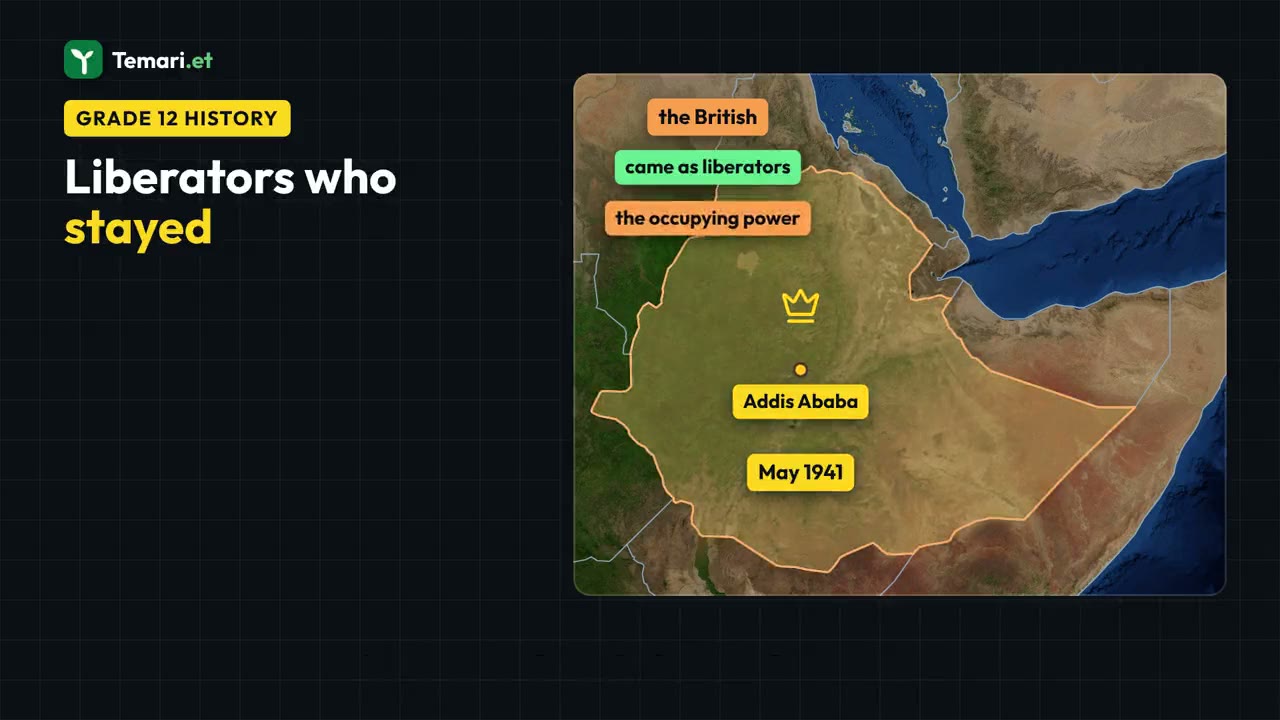
British minister's precedenceThe British minister had primacy over all other diplomatic representatives.This precedence was lifted.
Advisers and officialsBritish citizens held key civil and military posts and controlled the police and finance.The British right to appoint advisers and officials was lifted.
Ethiopian armyA British military mission trained the new Ethiopian army.The army was no longer controlled by British officers and command passed to the newly established Ministry of War.

When you use it

Use when a question asks how the 1942 Anglo-Ethiopian agreement limited Ethiopian sovereignty and how the 1944 agreement restored some of it.

Watch out

The 1942 agreement confirmed Ethiopia as a sovereign state in name, but almost every article showed dependence on Britain. Do not describe 1942 as full independence.

Drafted from Grade 12 History, pages 157-208, then checked twice before it went up

Practice questions on unit 6

10 multiple-choice questions written against this chapter, each with its answer and the reason. Try one before you open the answer.

Question 1

Which communications monitoring station in Asmera was leased to the United States for twenty-five years under the 1953 agreement?

  1. A.Kagnew
  2. B.Setit Humera
  3. C.Tendaho
  4. D.Piazza
Show the answer and why

Answer: A Kagnew

Why

In May 1953, the United States and Ethiopia concluded an agreement granting the US a 25-year lease on the Kagnew communications station in Asmera.

Question 2

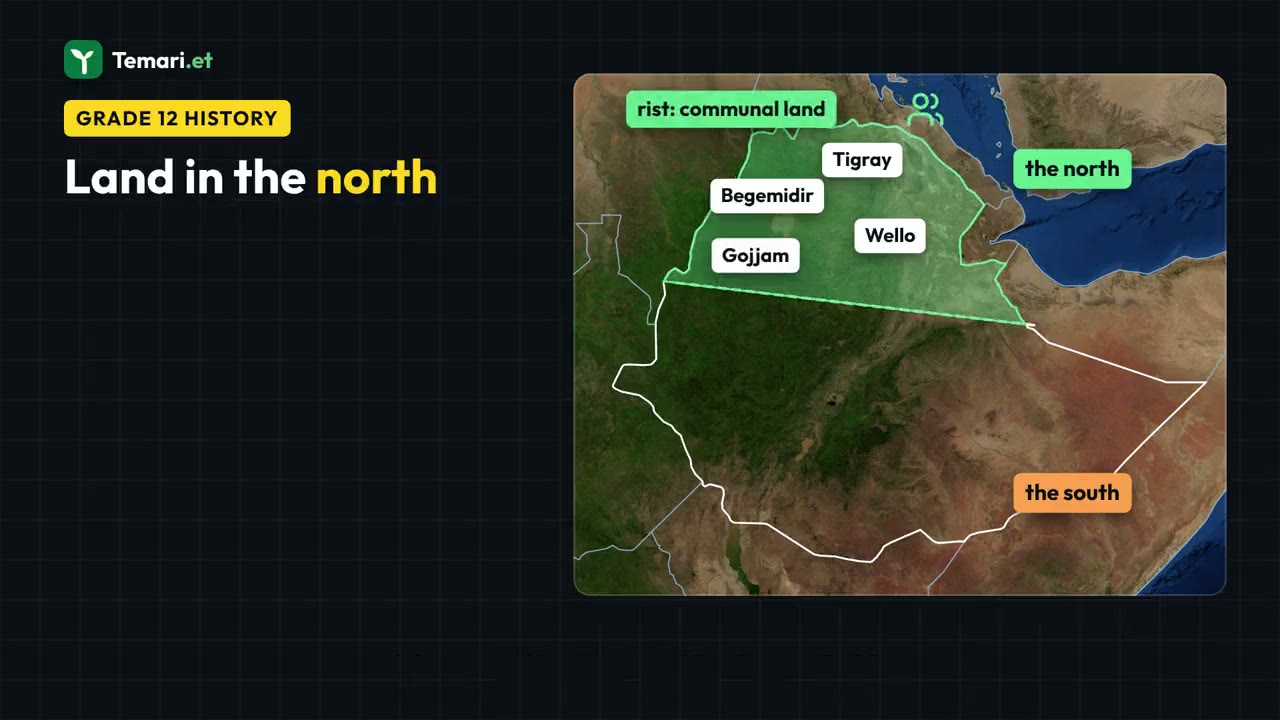
Under the imperial land tenure system, what was samon land?

  1. A.Land registered as government property
  2. B.Land granted to the Ethiopian Orthodox Church in perpetuity
  3. C.Land granted to war veterans as a temporary pension
  4. D.Communal land held by northern peasants
Show the answer and why

Answer: B Land granted to the Ethiopian Orthodox Church in perpetuity

Why

Samon was land that the imperial government granted to the Ethiopian Orthodox Church in perpetuity.

Question 3

Who was the prominent leader of the 1943 Woyane Rebellion in eastern Tigray?

  1. A.Waqo Gutu
  2. B.Hamid Idris Awate
  3. C.Blatta Hayle Mariam Redda
  4. D.Dajjach Belay Zeleke
Show the answer and why

Answer: C Blatta Hayle Mariam Redda

Why

The Woyane Rebellion of 1943 in eastern Tigray was led by Blatta Hayle Mariam Redda.

Question 4

The attempted coup d'etat of December 1960 was organized and led by which two brothers?

  1. A.Mengistu Neway and Germame Neway
  2. B.Belay Zeleke and Negash Bezabih
  3. C.Takele Wolde-Hawaryat and Geressu Duki
  4. D.Abebe Aregay and Jagama Kello
Show the answer and why

Answer: A Mengistu Neway and Germame Neway

Why

The 1960 coup attempt was led by Brigadier General Mengistu Neway and his brother Germame Neway, known as the Neway brothers.

Question 5

When the United Nations commission was sent to Eritrea in 1950, which two member countries recommended granting complete independence to Eritrea?

  1. A.South Africa and Burma
  2. B.Guatemala and Pakistan
  3. C.Norway and Guatemala
  4. D.Burma and Norway
Show the answer and why

Answer: B Guatemala and Pakistan

Why

The UN commission was divided: Guatemala and Pakistan recommended independence, South Africa and Burma recommended federation with Ethiopia, and Norway recommended union with Ethiopia.

Question 6

Under the 1942 land tax decree, how was rural land categorized based on its productivity?

  1. A.Rist, gult, and samon
  2. B.Mengist, maderia, and gabbar
  3. C.Lam, lam-taf, and taf
  4. D.Teklay-gizat, awraja, and wereda
Show the answer and why

Answer: C Lam, lam-taf, and taf

Why

The 1942 decree classified rural land by productivity into cultivated (lam), semi-cultivated (lam-taf), and uncultivated (taf).

Question 7

In which district did the Bale peasant rebellion first break out in 1963 after peasants refused to pay land taxes?

  1. A.Motta
  2. B.El Kere
  3. C.Kolla Dega Damot
  4. D.Dallo
Show the answer and why

Answer: B El Kere

Why

The Bale peasant rebellion began in 1963 in the El Kere district when local peasants refused to pay land taxes, later spreading to Wabe, Dallo, and Ganale.

Question 8

What political change was introduced by the 1955 Revised Constitution that was absent from the 1931 Constitution?

  1. A.Universal adult suffrage and an elected Chamber of Deputies
  2. B.The complete abolition of the monarchy
  3. C.The establishment of an elected Senate
  4. D.Equal land distribution for all peasants
Show the answer and why

Answer: A Universal adult suffrage and an elected Chamber of Deputies

Why

The 1955 revised constitution introduced universal adult suffrage and an elected Chamber of Deputies, whereas the Senate remained appointive.

Question 9

How did the Anglo-Ethiopian Agreement of 1944 modify the restrictions placed on Ethiopian sovereignty by the 1942 agreement?

  1. A.It restored full Ethiopian control over the entire Ogaden region immediately
  2. B.It lifted the precedence of the British minister and gave army control to the Ethiopian Ministry of War
  3. C.It established British trusteeship over both Eritrea and French Somaliland
  4. D.It placed the Imperial Highway Authority under Ethiopian management
Show the answer and why

Answer: B It lifted the precedence of the British minister and gave army control to the Ethiopian Ministry of War

Why

The December 1944 agreement restored some sovereign rights: the British minister lost diplomatic precedence, British rights to appoint advisers were lifted, and army command was transferred to the Ethiopian Ministry of War.

Question 10

Which rural development program was introduced in 1971 with sponsorship from the Swedish International Development Agency (SIDA)?

  1. A.Imperial Board of Telecommunications
  2. B.Minimum Package Program (MPP)
  3. C.Peace Corps Secondary Program
  4. D.National Economic Council Project
Show the answer and why

Answer: B Minimum Package Program (MPP)

Why

In 1971, the Ministry of Agriculture introduced the Minimum Package Program (MPP), sponsored by SIDA, following the pilot project Chilalo Agricultural Development Unit (CADU).

The app holds 12 questions on this unit, marked as you go. These are the first 10.

The textbook pages for unit 6

Unit 6 runs from page 157 to page 208 of the Ministry of Education edition.

Ministry of Education edition, English, 290 pages

Download the PDF

Practise this unit in the app

Temari turns this chapter into timed practice and marks it as you go, with an AI tutor to explain anything that did not land.

Start free

Temari.et is also an Android app, free on Google Play.

Sign inCreate your account