Grade 9 Chemistry unit 5
Why a shared pair holds two atoms together
1:14 · Explainer 2 of 2 on unit 5
A short animated Temari explainer on Grade 9 Chemistry unit 5: Why a shared pair holds two atoms together. Every word it says is written out under the video.
Everything the explainer says
The explainer's words, part by part, as its captions show them.
Two atoms, one shared pair
Two hydrogen atoms each have one electron.
Neither can take the other's electron, so they share both as a pair between them.
Sharing a pair like this is a covalent bond.
What holds them together
Each nucleus attracts the shared pair, and that pull holds the two atoms together.
But the two nuclei push each other apart, and so do the two electrons.
That push is why the two nuclei never collide.
The atoms settle where the pulls and pushes balance.
Bonding lowers the energy
The bonded molecule has less energy than the two separate atoms, so it is stable.
The pair counts for both
Each atom counts both shared electrons, so each hydrogen has two, like helium.
Sulfur has six outer electrons and needs two more.
It shares a pair with each of two hydrogens: hydrogen sulfide.
Counting both pairs, sulfur has eight, like argon.
How a covalent bond holds
In a covalent bond, two atoms share a pair of electrons, and both nuclei pull on it.
Save this one for revision.
The full lesson on unit 5
Temari's longer video lesson on this chapter, with every word written out on its page.
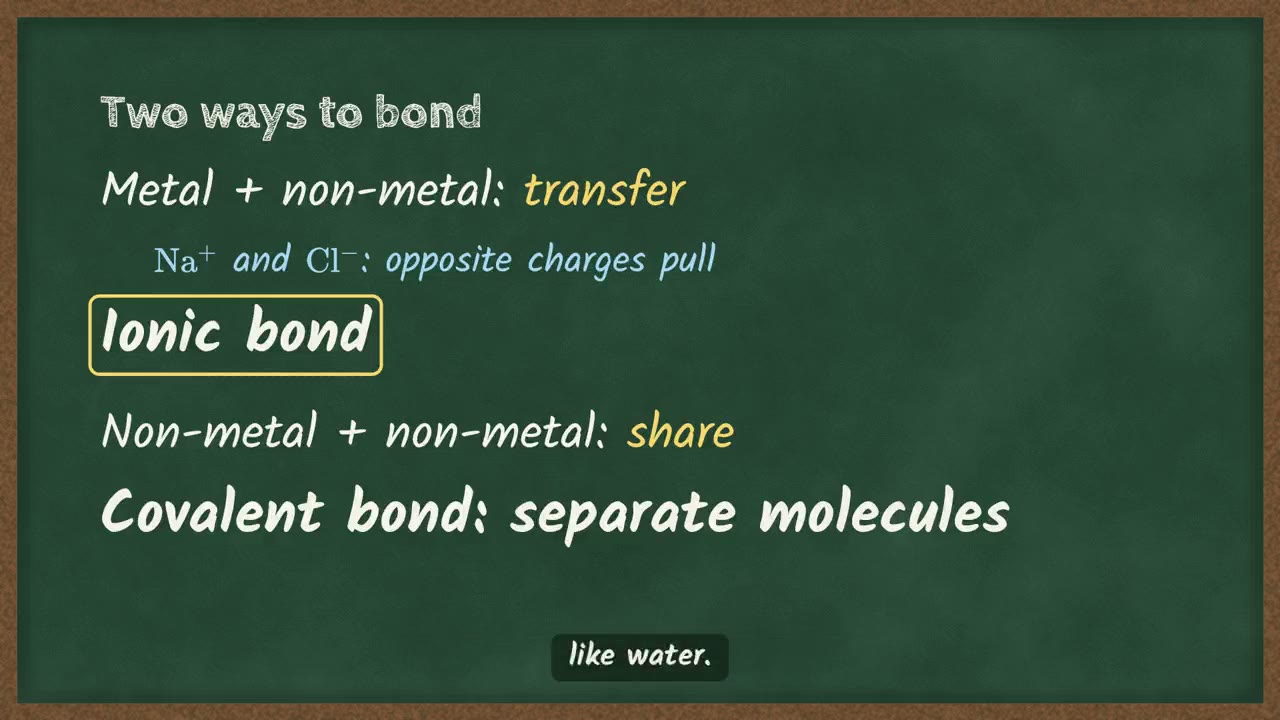 Ionic or covalent: how the bond decides the properties4 min
More explainers on unit 5
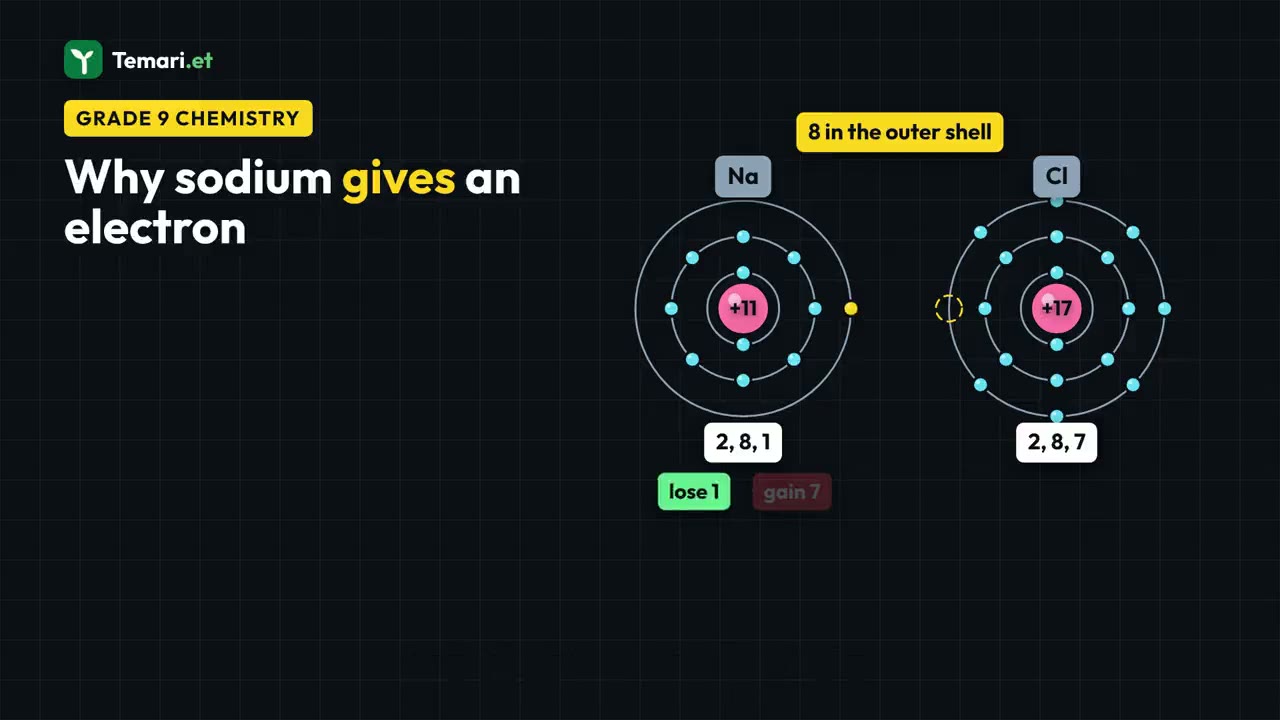
More on unit 5
The chapter's own page holds the rest of what Temari has on it, such as short notes and practice questions with their answers.
Open the unit 5 pagePractise this unit in the app
Temari turns this chapter into timed practice and marks it as you go, with an AI tutor to explain anything that did not land.
Start free
Temari.et is also an Android app, free on Google Play.

