Grade 9 Chemistry unit 5
How a moving electron makes an ionic bond
1:29 · Explainer 1 of 2 on unit 5
A short animated Temari explainer on Grade 9 Chemistry unit 5: How a moving electron makes an ionic bond. Every word it says is written out under the video.
Everything the explainer says
The explainer's words, part by part, as its captions show them.
Why sodium gives an electron
Sodium has eleven electrons: two, eight and one.
Chlorine has seventeen: two, eight and seven.
An atom is most stable with eight in its outer shell, like a noble gas.
Losing one electron is far easier than gaining seven.
One electron moves across
So sodium's outer electron moves across to chlorine.
Sodium is left with two and eight, like neon.
Chlorine now has two, eight and eight, like argon.
Count the charges
Sodium has eleven protons and ten electrons: one plus.
Chlorine has seventeen protons and eighteen electrons: one minus.
Atoms with a charge are called ions.
Opposite charges attract
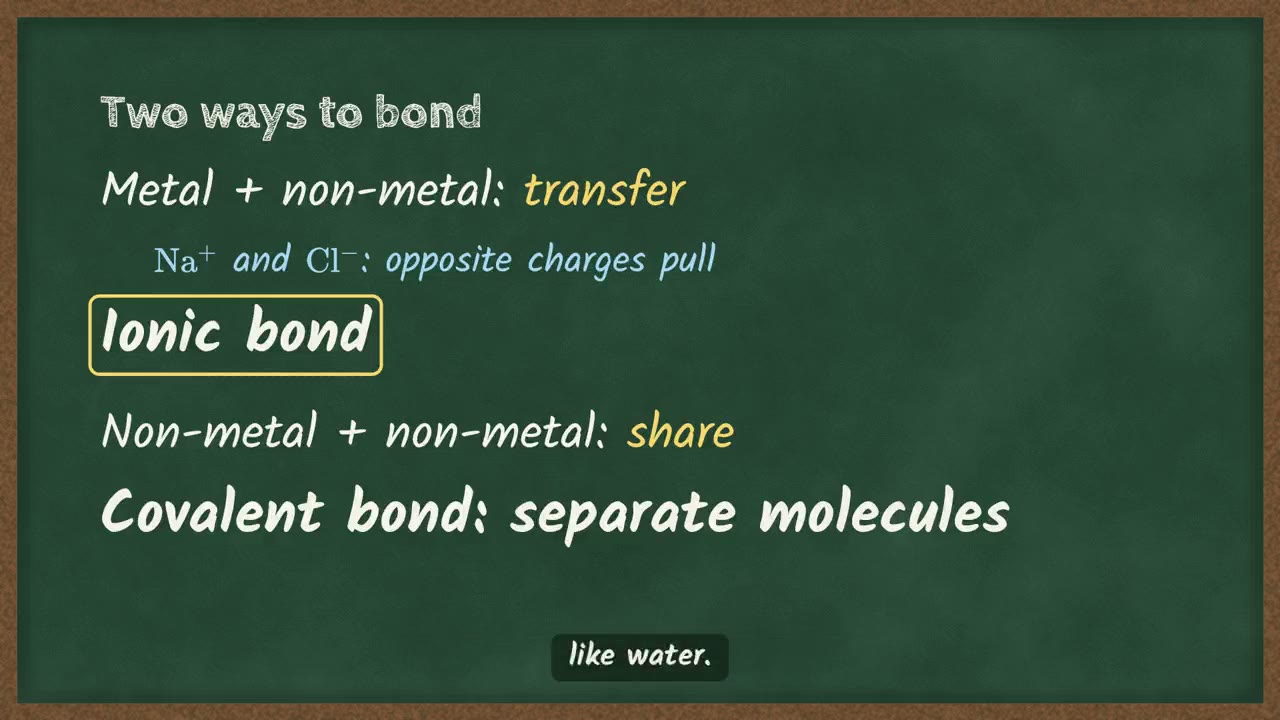
Opposite charges attract.
That electrostatic pull is the ionic bond, and it makes sodium chloride.
Two electrons, two charges
Magnesium has two outer electrons, and oxygen six.
Both go to oxygen, making eight.
Magnesium becomes two plus, oxygen two minus: magnesium oxide.
How an ionic bond forms
The metal gives electrons, the non-metal takes them, and the ions attract.
Save this one for revision.
The full lesson on unit 5
Temari's longer video lesson on this chapter, with every word written out on its page.
 Ionic or covalent: how the bond decides the properties4 min
More explainers on unit 5
More on unit 5
The chapter's own page holds the rest of what Temari has on it, such as short notes and practice questions with their answers.
Open the unit 5 pagePractise this unit in the app
Temari turns this chapter into timed practice and marks it as you go, with an AI tutor to explain anything that did not land.
Start free
Temari.et is also an Android app, free on Google Play.

