Grade 9 Citizenship unit 3
Which way does power flow?
1:16 · Explainer 1 of 3 on unit 3
A short animated Temari explainer on Grade 9 Citizenship unit 3: Which way does power flow?. Every word it says is written out under the video.
Everything the explainer says
The explainer's words, part by part, as its captions show them.
Power once flowed down
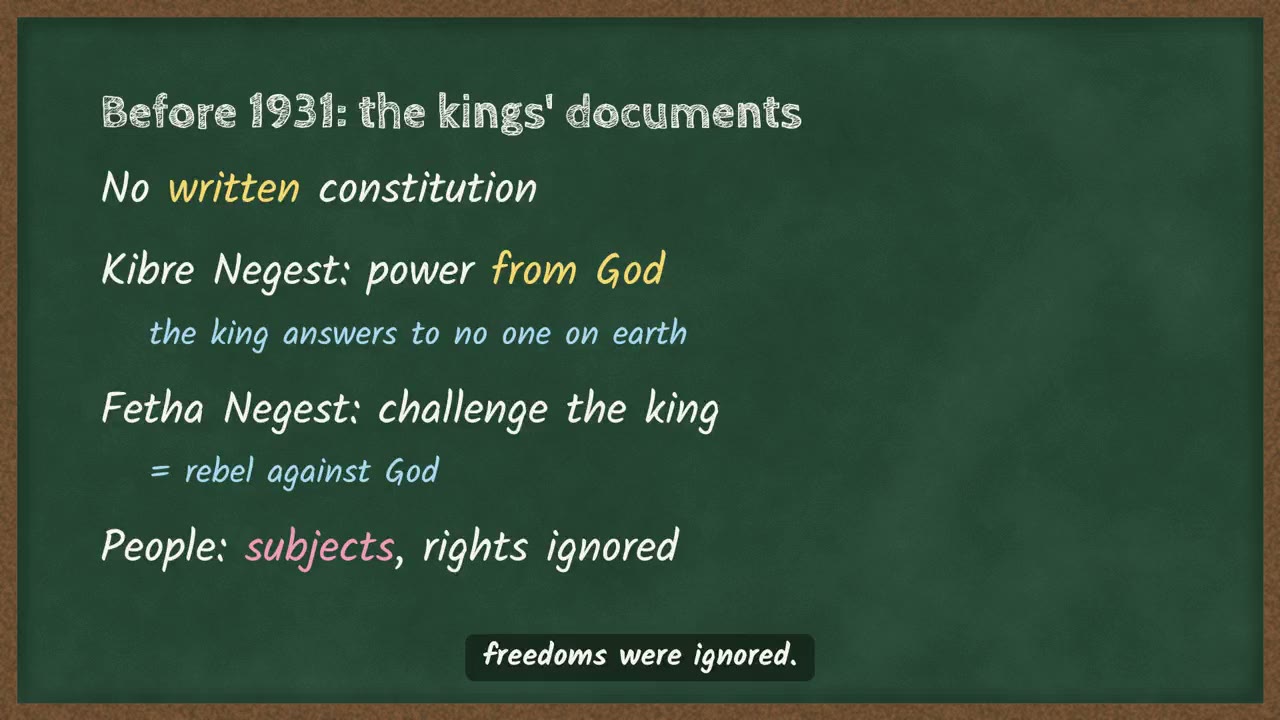
Before 1931, Ethiopia had no written constitution, and emperors ruled by tradition.
Old documents said the monarchs got their power from God, so they answered to no earthly power.
The people were only subjects, with no say in their government's decisions.
Now power flows up
The 1995 constitution turns the arrow around.
Its Article 8 is popular sovereignty: the people are the ultimate source of power.
So the government must rest on the consent of the people.
And a constitution limits the government: it may act only within the powers and functions the constitution gives it.
And power answers back
Then the loop closes, through transparency and accountability.
Transparency means officials' conduct and actions are open to the public.
Accountability means officials are held responsible for any failure in their duties.
And under the rule of law, the law applies to everyone, even those in power.
Popular sovereignty
Power comes from the people, stays inside the constitution's limits, and answers to the people.
Save this one for revision.
The full lesson on unit 3
Temari's longer video lesson on this chapter, with every word written out on its page.
 Ethiopia's constitutions, from 1931 to 19955 min
More explainers on unit 3
More on unit 3
The chapter's own page holds the rest of what Temari has on it, such as short notes and practice questions with their answers.
Open the unit 3 pagePractise this unit in the app
Temari turns this chapter into timed practice and marks it as you go, with an AI tutor to explain anything that did not land.
Start free
Temari.et is also an Android app, free on Google Play.

