Grade 11 Physics unit 7
Why an oxygen nucleus weighs less than its parts
1:16 · Explainer 2 of 2 on unit 7
A short animated Temari explainer on Grade 11 Physics unit 7: Why an oxygen nucleus weighs less than its parts. Free to watch, no account needed.
Everything the explainer says
The explainer's words, part by part, as its captions show them.
Weigh the parts of a nucleus
An oxygen-16 nucleus has eight protons and eight neutrons.
Each has a mass just over one unit.
Weigh them one by one: 16.1276 u in all.
The nucleus is lighter
Now weigh the whole nucleus: 16 u.
So the nucleus is lighter than its parts.
The missing mass is called the mass defect.
Where did the mass go?
The difference is 0.1276 u.
Where did it go?
It was given out as energy when the nucleus formed.
That energy, the binding energy, holds the nucleons together.
Turn the mass into energy
Each atomic mass unit is worth 931.1 MeV.
So the binding energy is about 118.8 MeV.
Divide by sixteen nucleons: about 7.4 MeV each.
That is called the binding energy per nucleon.
Mass defect and binding energy
A nucleus always weighs less than its parts.
Save this one for revision.
The full lesson on unit 7
Temari's longer video lesson on this chapter, with every word written out on its page.
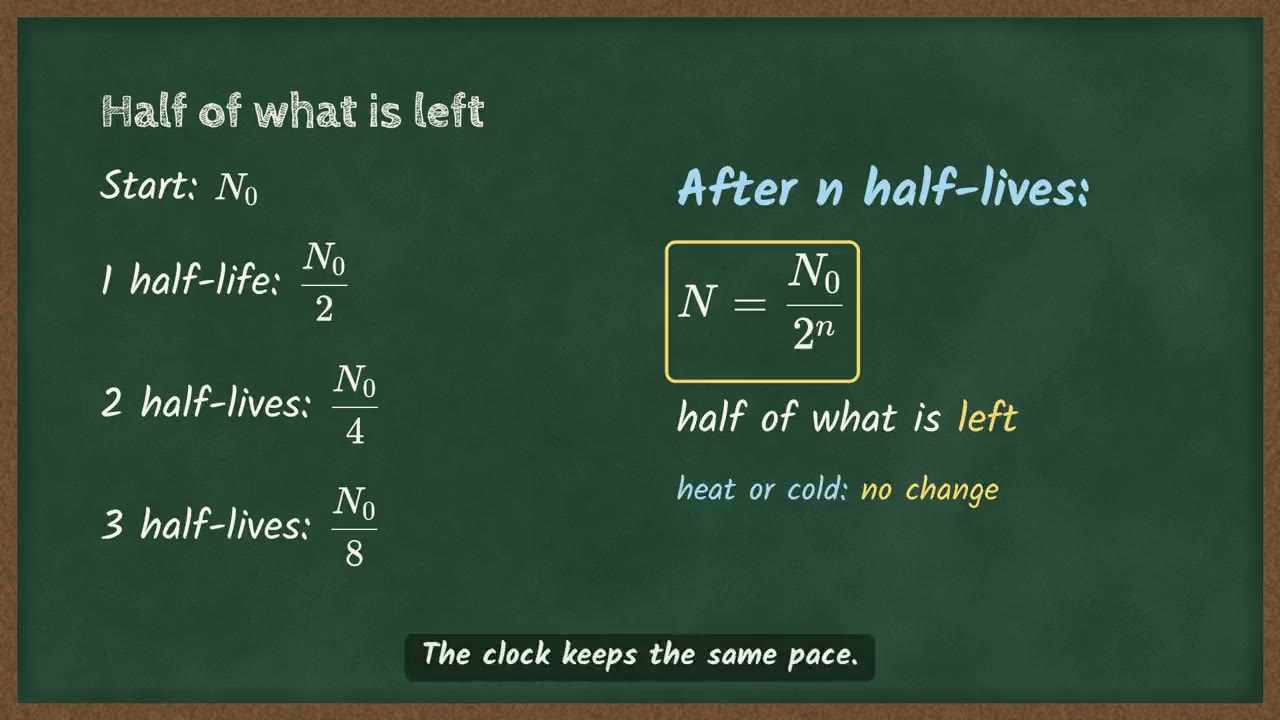 Half-life: the clock inside the nucleus4 min
More explainers on unit 7
More on unit 7
The chapter's own page holds the rest of what Temari has on it, such as short notes and practice questions with their answers.
Open the unit 7 pagePractise this unit in the app
Temari turns this chapter into timed practice and marks it as you go, with an AI tutor to explain anything that did not land.
Start free
Temari.et is also an Android app, free on Google Play.

