On this page
Who the extension call is open to
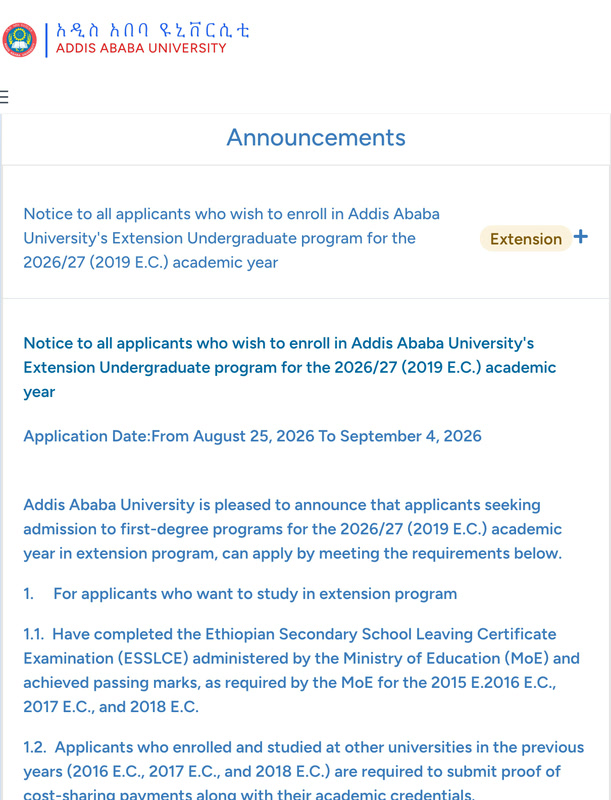
The notice is short about eligibility, and shorter than the regular one. Five conditions are named, and an applicant needs the ones that describe them.
- A pass in the Ethiopian Secondary School Leaving Certificate Examination from 2015, 2016, 2017 or 2018 E.C., at the marks the Ministry of Education requires.
- Anyone who enrolled at another university in 2016, 2017 or 2018 E.C. brings proof that the cost-sharing was paid, alongside their credentials.
- The university's own Undergraduate Admission Test, at or above its minimum passing score.
- A willingness to take the field the university places them in, if their results do not reach the department they chose.
- Remedial education in 2018 E.C., with the qualifying exam passed.
One thing is missing rather than different. The regular call spends four sections on who pays: government cost-sharing, presidential sponsorship, teachers education sponsorship and self-payment. The extension notice carries no sponsorship section at all. It does not say that an extension student pays their own way, but it names no route by which anyone else would.
Where the two notices part company
Reading the regular instructions and applying them to an extension application goes wrong in four places.
| Regular | Extension | |
|---|---|---|
| Who pays | Cost-sharing, self-payment, presidential or teachers education sponsorship | No sponsorship route is named |
| Programme choices | Ten for a self-paying applicant, or Natural Science Freshman or Social Science Freshman for cost-sharing | Three, in order of priority |
| Papers to upload | The Grade 12 result certificate and the Grade 9 to 12 transcript | The same pair, or a previous degree, or a vocational level 4 COC result |
| Admission type to select | Regular | Extension |
| Extra assessment | Set by health related fields, law and some others | None named |
How to apply, including the step that looks wrong
Open the portal
Go to admission.aau.edu.et, choose Undergraduate application, then Apply, then Call for Undergraduate Regular Admission, and read the programmes before pressing Apply now.
Prove who you are
Enter the Fayda number and validate it, then type the one-time code sent by SMS. Create an account with a working email address and a password of at least eight characters. That pair is the way back in.
Fill the academic profile, then choose Extension
Complete the form, press Update and then Next. On the admission type, select Extension. This is the step that separates the two calls.
Pick three programmes
Choose three in the order you want them, then continue. The regular call's ten choices do not apply here.
Upload what you have
Attach the school certificate and the Grade 9 to 12 transcript, or a previous degree, or a vocational level 4 COC result. Then select the town where you want to sit the test.
Accept and pay
Read the consent statements, check the summary, then pay 750 birr through Telebirr or by scanning the QR code. The fee is not returned.
Collect the ticket
Download the test ticket and the schedule from the portal. The result and the admission decision appear in the same place afterwards.
The test, and how you learn where to sit it
The test is taken on computer, on the university's own network, and the notice publishes no single timetable. Each candidate is told their centre, date and time separately, on the university web page and on the testing centre's Telegram channel at t.me/aauGAT. The notice asks applicants to check it daily from the day they apply. Someone who files on the first day waits thirteen days for the test, and the assignment can land on any of them.
A way in for regular applicants who were not admitted
On 17 September 2026 (Meskerem 7, 2019 E.C.) the university said that anyone who applied for the regular programme for 2019 E.C., sat the competition and was not admitted can apply to the extension programme if they scored 50 or more on the university's entrance test (UAT). The announcement, carried by Tikvah University and Tikvah Education, gives no application window and no address. The extension window described above closed on 4 September, so watch the admissions portal for how this route is opened before you pay anything.
Sources
Every figure and date above comes from one of these. Open them; a story about your child's school is worth checking.
- 1Undergraduate announcements (both notices, extension expanded)Addis Ababa University admissions portal
- 2አዲስ አበባ ዩኒቨርሲቲ በ2019 የትምህርት ዘመን አዲስ ተማሪዎችን ተቀብሎ ማስተማር ይፈልጋልTikvah Education, 29 August 2026 (ነሐሴ 23 ቀን 2018 ዓ.ም.)
- 3በአዲስ አበባ ዩኒቨርሲቲ በመደበኛው መርሐግብር ቅበላ ያላገኛችሁ አመልካቾች UAT 50 እና ከዚያ በላይ ካላችሁ በExtension ማመልከት ትችላላችሁTikvah University, 17 September 2026 (መስከረም 07 ቀን 2019 ዓ.ም.)
- 4በአዲስ አበባ ዩኒቨርሲቲ በመደበኛው መርሐግብር ቅበላ ያላገኛችሁ አመልካቾች UAT 50 እና ከዚያ በላይ ካላችሁ በExtension ማመልከት ትችላላችሁTikvah Education, 17 September 2026 (መስከረም 07 ቀን 2019 ዓ.ም.)