Grade 12 Mathematics unit 3
How a long tail pulls the mean away from the mode
1:28 · Explainer 2 of 2 on unit 3
A short animated Temari explainer on Grade 12 Mathematics unit 3: How a long tail pulls the mean away from the mode. Free to watch, no account needed.
Everything the explainer says
The explainer's words, part by part, as its captions show them.
Where do the mean, median and mode sit?
This curve shows how often each value turns up. It is symmetrical, the same on both sides.
The mode, the most common value, is at the peak. The median splits the data in half. The mean is the average. Here, all three sit together.
A long tail pulls the mean
Now give the data a long tail to the right: a few very large values.
The mode stays at the peak. The median moves a little. The mean, which uses every value, is pulled furthest.
Mean > median > mode means positive skew: skewed to the right.
Tail to the left, the order flips
Turn the tail to the left, toward small values, and the order flips.
Mean < median < mode means negative skew: skewed to the left.
Skewness as a number
Pearson's coefficient puts a number on it: 3 times mean minus median, over the standard deviation.
Your textbook's example has mean 108, median 110 and standard deviation 5.7.
That gives about −1.05. Negative, so skewed to the left.
Pearson's coefficient of skewness
When a long tail pulls the mean past the median, the data is skewed toward that tail.
Save this one for your exam.
The full lesson on unit 3
Temari's longer video lesson on this chapter, with every word written out on its page.
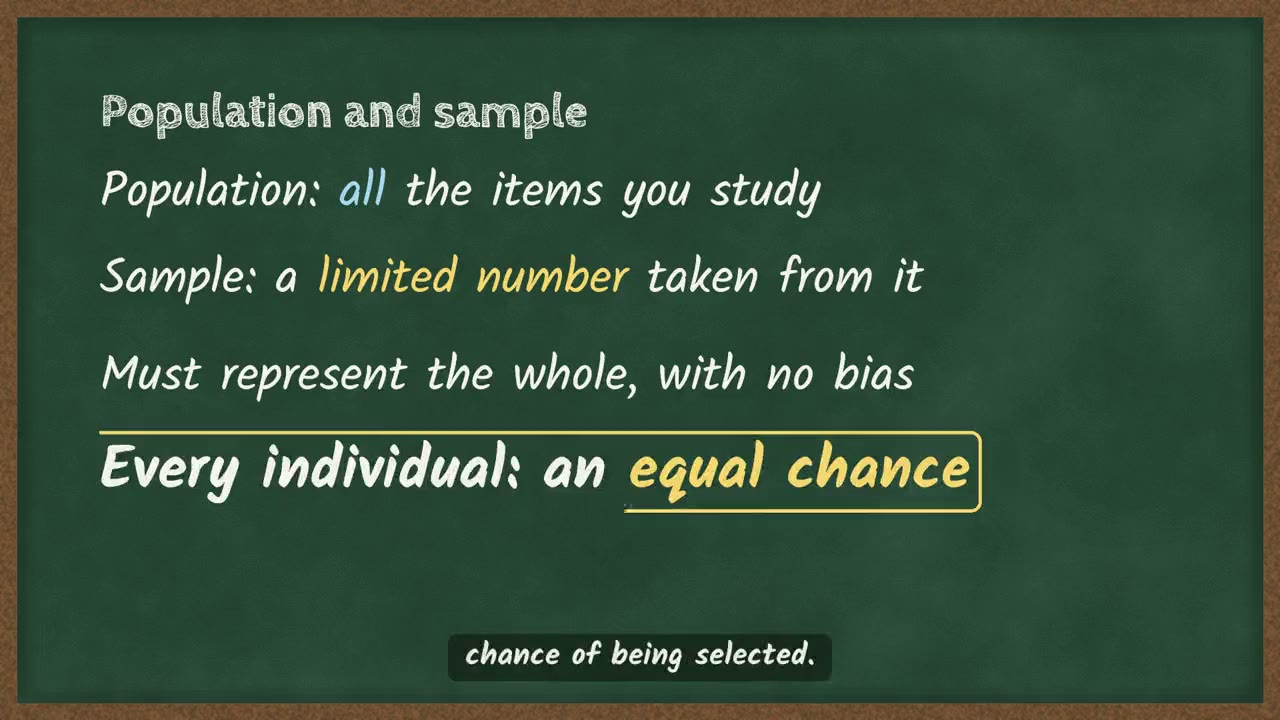 Four ways to choose a random sample4 min
More explainers on unit 3
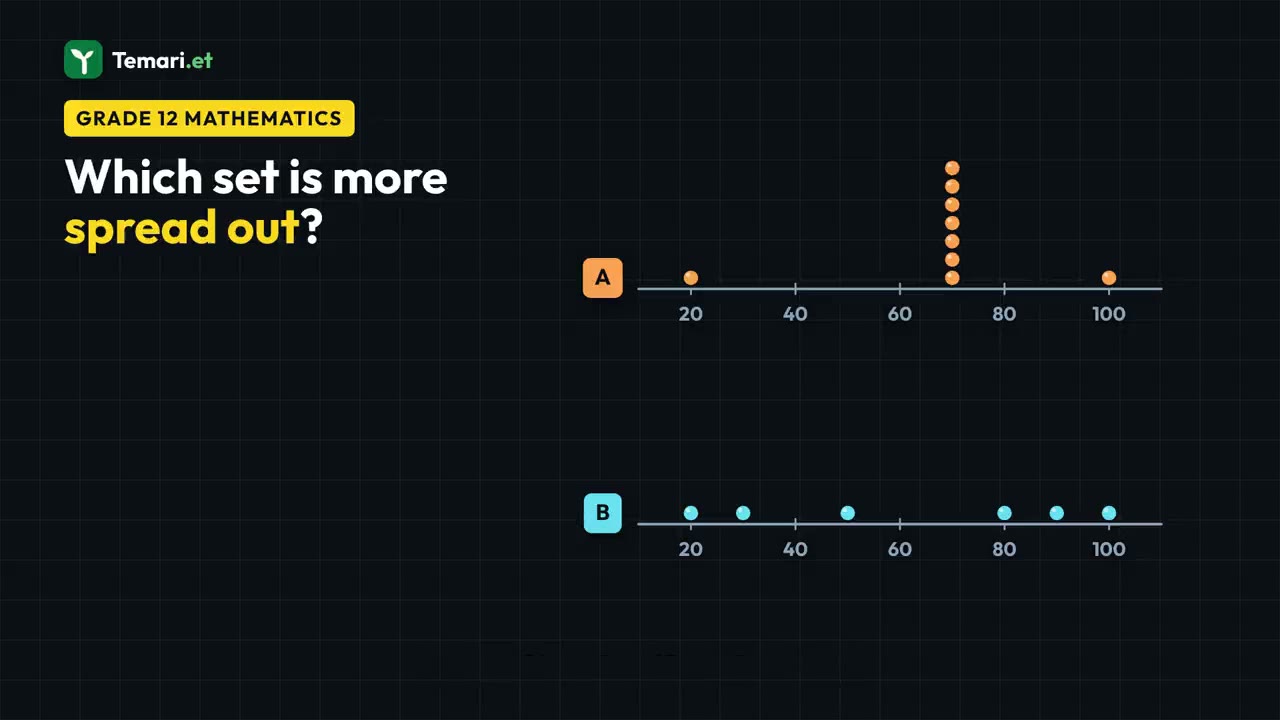
More on unit 3
The chapter's own page holds the rest of what Temari has on it, such as short notes and practice questions with their answers.
Open the unit 3 pagePractise this unit in the app
Temari turns this chapter into timed practice and marks it as you go, with an AI tutor to explain anything that did not land.
Start free
Temari.et is also an Android app, free on Google Play.

