On this page
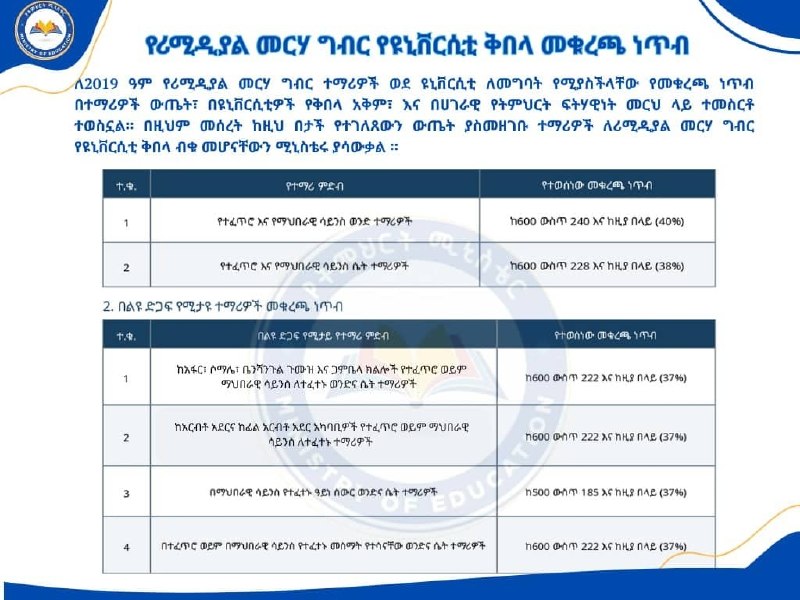
The cut-off for the two streams
| Who | Mark | Share |
|---|---|---|
| Male students, natural and social science | 240 out of 600 | 40% |
| Female students, natural and social science | 228 out of 600 | 38% |
The four supported groups
The Ministry lists four groups whose cut-off sits at 37 percent. The first two are about where a candidate comes from and the last two about disability. Blind candidates in social science are the one group whose paper is marked out of 500 rather than 600, which is why their mark reads lower for the same share.
| Group | Stream | Mark |
|---|---|---|
| Candidates from Afar, Somali, Benishangul-Gumuz and Gambella | Natural or social science | 222 out of 600 (37%) |
| Candidates from pastoral and semi-pastoral areas | Natural or social science | 222 out of 600 (37%) |
| Blind candidates | Social science | 185 out of 500 (37%) |
| Deaf candidates | Natural or social science | 222 out of 600 (37%) |
How the Ministry says it set the marks
The notice gives three grounds: the results the students achieved, the capacity universities have to admit, and what it calls the national principle of fairness in education. It gives no count of students who reached the marks and no count of places, so the size of this year's remedial entry into university is not yet public.
Where to check your result, and what the notice leaves out
The remedial results themselves opened on 1 September 2026 at result.ethernet.edu.et, under Remedial Examination, and the route is in our item on the release. This notice sets the mark and stops: it does not say when students above it choose a university and a field, or on which portal. It says nothing about the results that came back marked Disqualified either; the only correction on those so far is Debre Tabor's.
Sources
Every figure and date above comes from one of these. Open them; a story about your child's school is worth checking.